Calculateur de laboratoire · RCF · RPM · rayon du rotor
Convertir RCF et RPM pour les centrifugeuses
Le calculateur convertit RCF en RPM ou RPM en RCF Deux valeurs sont nécessaires : la force centrifuge ou la vitesse de rotation, ainsi que le rayon maximal du rotor.
Réponse directe
Saisissez le rayon du rotor en millimètres et la valeur de départ connue. Le résultat est calculé immédiatement et localement dans le navigateur. Pour transposer techniquement un protocole, la RCF ou la valeur × g est plus pertinente que les RPM seules.
Calculer la force centrifuge ou la vitesse de rotation
Choisissez le sens du calcul et saisissez deux valeurs. Les valeurs décimales sont acceptées.
Tours par minute
RPM
Axe de rotation jusqu’au fond du tube
mm
Insérer rapidement le rayon
RésultatForce centrifuge relative calculée
Force centrifuge relative
× g
Axe de rotation jusqu’au fond du tube
mm
Insérer rapidement le rayon
RésultatRPM requises pour la RCF sélectionnée
ⓘ
Le calculateur effectue une conversion mathématique. Les indications approuvées des fabricants des tubes et de la centrifugeuse restent déterminantes.
Bien distinguer les termes
Que signifient RCF et RPM ?
RCF et RPM ne décrivent pas la même chose. La RCF indique la force centrifuge relative agissant sur l’échantillon comme multiple de l’accélération de la pesanteur. Les RPM décrivent uniquement la vitesse du rotor.
Règle essentielleDes RPM identiques ne signifient pas automatiquement un même × g si le rayon du rotor diffère.
01
RCF ou × g
La force centrifuge relative décrit l’accélération agissant sur l’échantillon au rayon choisi. Elle est exprimée en × g.
02
RPM ou tr/min
RPM signifie tours par minute. Cette valeur décrit la vitesse du rotor mais ne tient pas compte de son rayon.
03
Rayon du rotor rmax
Pour ce calculateur, il s’agit de la distance entre l’axe de rotation et le fond du tube inséré dans sa position de fonctionnement.
Pourquoi la RCF est-elle plus importante pour transposer un protocole ?
Un protocole indiquant uniquement une vitesse de rotation ne peut pas être transposé sans ambiguïté à un autre appareil sans connaître le rayon. La RCF relie la vitesse au rayon réel.
Déterminer correctement rmax
Quel rayon du rotor faut-il saisir ?
Utilisez le rayon maximal du rotor : la distance entre l’axe de rotation et le fond du tube lorsque le rotor, l’adaptateur et le tube sont positionnés comme en fonctionnement.
Ne pas estimerLa valeur peut varier selon le rotor, l’adaptateur, la longueur du tube et la position de fonctionnement.
1
Consulter la notice La documentation de l’appareil ou du rotor constitue la première source.
2
Utiliser la configuration réelle Le rotor, l’adaptateur et le tube doivent correspondre à la configuration utilisée.
3
Mesurer jusqu’au fond du tube Ne pas mesurer jusqu’au bord supérieur du rotor ou de l’adaptateur.
Important : Ne reprenez pas sans vérification un rayon provenant d’un autre modèle de centrifugeuse ou d’un adaptateur différent.
Base mathématique
Convertir RCF en RPM et RPM en RCF
La formule utilise le rayon du rotor en centimètres. Le calculateur reçoit la valeur en millimètres et la divise en interne par dix.
Attention à l’unitéDans la formule, 86 mm correspondent à 8,6 cm.
RPM → RCF
Convertir RPM en × g
RCF = 1,118 × 10⁻⁵ × r(cm) × RPM²
La vitesse de rotation et le rayon du rotor sont connus. La force centrifuge relative est recherchée.
RCF → RPM
Convertir × g en RPM
RPM = √[RCF ÷ (1,118 × 10⁻⁵ × r(cm))]
La RCF cible et le rayon du rotor sont connus. La vitesse nécessaire est recherchée.
Calculs fréquemment recherchés
Exemples typiques de calcul RCF/RPM
Les tableaux présentent uniquement des exemples mathématiques. Ils ne définissent aucun protocole et ne remplacent ni l’autorisation de l’appareil ni les instructions du fabricant.
À retenirPour une même RCF cible, un rayon plus petit nécessite une vitesse de rotation plus élevée.
Exemple 01
Convertir 1000 × g en RPM
Vitesse calculée nécessaire pour 1000 × g
Rayon du rotor
Vitesse calculée
50 mm
env. 4230 RPM
86 mm
env. 3225 RPM
100 mm
env. 2991 RPM
Exemple 02
Convertir 1200 × g en RPM
Vitesse calculée nécessaire pour 1200 × g
Rayon du rotor
Vitesse calculée
50 mm
env. 4633 RPM
65 mm
env. 4064 RPM
85 mm
env. 3554 RPM
86 mm
env. 3533 RPM
100 mm
env. 3276 RPM
110 mm
env. 3124 RPM
Exemple 03
Convertir 3500 RPM en × g
RCF calculée à 3500 RPM
Rayon du rotor
RCF calculée
50 mm
env. 685 × g
86 mm
env. 1178 × g
100 mm
env. 1370 × g
Exemple 04
Que signifie 300 × g pour une centrifugeuse ?
300 × g décrit une accélération correspondant mathématiquement à 300 fois l’accélération de la pesanteur. La vitesse correspondante dépend du rayon du rotor. Avec un rayon de 86 mm, il faudrait environ 1766 RPM seraient nécessaires.
Protocole standard du fabricant
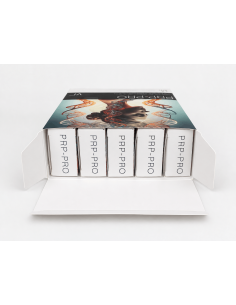
Vi PRP-PRO : 1200 × g pendant 7 minutes
Pour la préparation avec les tubes PRP Vi PRP-PRO le protocole standard de centrifugation est 1200 × g pendant 7 minutes. Les RPM nécessaires sont calculées à partir du rayon réel du rotor de la centrifugeuse utilisée.
Les valeurs RPM calculées sont arrondies mathématiquement. Utilisez uniquement des réglages pris en charge par la centrifugeuse, le rotor, l’adaptateur et le système de tubes.
À vérifier avant de commencer
Transposer techniquement un protocole de centrifugation
La conversion entre RCF et RPM n’est qu’une partie du processus. D’autres paramètres peuvent influencer la transposabilité.
Limite du calculateurUne équivalence mathématique ne signifie pas automatiquement une validation technique ou réglementaire.
01
RCF cible et durée
Respecter intégralement les indications validées du système de tubes.
02
Rotor et adaptateur
Vérifier le type de rotor, le rayon réel, l’adaptateur et la position du tube.
03
Limites de l’appareil
Respecter la vitesse autorisée, la RCF, le chargement et les récipients compatibles.
04
Accélération et freinage
Ne pas omettre les consignes relatives aux rampes, au freinage et à la température.
05
Charger symétriquement
Respecter les indications du fabricant concernant l’équilibrage et la contre-charge.
06
Validation responsable
Les procédures internes validées et les documents du fabricant restent déterminants.
Remarque technique : Le calculateur ne fournit ni recommandation médicale ni protocole autonome de centrifugation. Il convertit mathématiquement des valeurs techniques connues.
Pages techniques associées
Vérifier ensemble le système de tubes et la centrifugeuse
La conversion n’est pertinente que si la RCF cible, le rotor, l’adaptateur, le récipient et les limites de l’appareil sont compatibles.
WorkflowValeur du protocole → rayon du rotor → vitesse → validation de l’appareil.
Saisissez la RCF cible et le rayon maximal du rotor. Le calculateur utilise la formule RPM = √[RCF ÷ (1,118 × 10⁻⁵ × r(cm))].
Comment convertir RPM en RCF ou × g ?
Saisissez les RPM et le rayon maximal du rotor. Le calculateur utilise la formule RCF = 1,118 × 10⁻⁵ × r(cm) × RPM².
Pourquoi les RPM seules ne suffisent-elles pas ?
La RCF agissant sur l’échantillon dépend à la fois de la vitesse de rotation et du rayon du rotor. Deux centrifugeuses peuvent donc produire des valeurs × g différentes à RPM identiques.
Quel rayon du rotor dois-je utiliser ?
Utilisez rmax : la distance entre l’axe de rotation et le fond du tube inséré en position de fonctionnement. Le rotor et l’adaptateur doivent correspondre à la configuration réellement utilisée.
Combien de RPM correspondent à 1200 × g ?
Cela dépend du rayon du rotor. Avec un rayon de 86 mm, 1200 × g correspondent à environ 3533 RPM ; avec 100 mm, à environ 3276 RPM.
Quelle RCF obtient-on à 3500 RPM avec un rayon de 86 mm ?
La conversion mathématique donne environ 1178 × g. Un réglage arrondi de l’appareil peut donc différer légèrement de la valeur cible calculée.
Le calculateur peut-il être utilisé pour les protocoles PRF ?
La conversion mathématique est indépendante du type d’échantillon. La RCF cible, la durée et les autres paramètres doivent toutefois provenir du protocole applicable et validé.
Pourquoi le résultat est-il arrondi ?
Le calculateur affiche une valeur entière arrondie. De nombreuses centrifugeuses ne peuvent en outre être réglées que par paliers fixes de vitesse. Le réglage utilisable doit être vérifié avec les spécifications de l’appareil.
Le tube VI PRP-PRO en verre offre une solution moderne pour la production de plasma riche en plaquettes (PRP) et garantit une stabilité et une fiabilité accrues dans le traitement grâce au matériau en verre. Développé avec une technologie innovante et certifié CE (0425-MED-004180-00), il garantit la plus grande sécurité et efficacité.
Caractéristiques...
You need to login or create account
Save products on your wishlist to buy them later or share with your friends.