
Shopping Cart
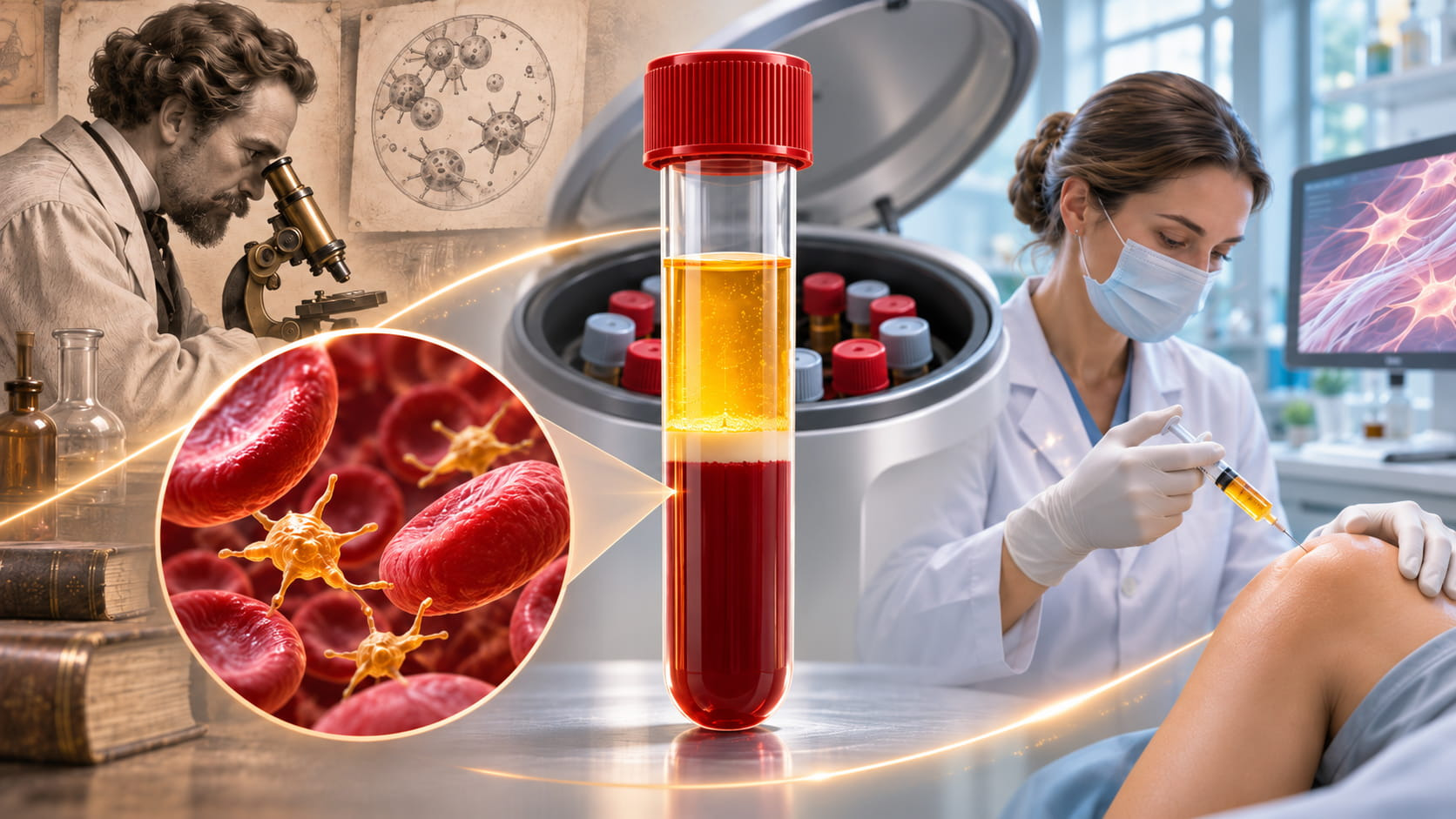
Medical history · PRP science
Five mysteries, four false leads and one unanswered question
Tiny particles in the blood that baffled scientists for decades. A centrifuge. A surprise in a laboratory dish. And studies that still disagree. The history of platelet-rich plasma reads almost like a detective story — explore it with interactive illustrations.
A drop of blood looks ordinary: red, liquid, nothing more. But every microlitre contains hundreds of thousands of tiny particles. They have no cell nucleus and survive for only around a week, yet they have fascinated researchers for over 180 years.
These particles are platelets. Their story eventually led to the three letters PRP: platelet-rich plasma. No single person invented it on one day. Each discovery prompted a new question, and some familiar explanations turn out to be false leads.
Key points at a glance
- PRP is blood plasma enriched with platelets. It is obtained by processing blood in a centrifuge.
- The name originated in coagulation research and blood banking. Its use in the scientific literature is documented from 1954; there is no single inventor.
- In 1974, laboratory studies demonstrated that platelets release substances that can stimulate cell proliferation. This led to new medical research questions.
- Sports news made PRP widely known from around 2009. Its clinical effects still have to be assessed for each indication because PRP is not a uniform preparation.
Mystery 1Paris · Bonn · Turin · 1842–1882
Mystery 1: What are those particles in the blood?
Paris, 1842. Physician Alfred Donné examines blood through a microscope. Red and white blood cells are already known, but he also observes tiny particles whose function is unclear. Are they impurities or fragments of other cells? At the time, no one can say.
In 1865, anatomist Max Schultze describes these particles more precisely. In 1882, Giulio Bizzozero studies injured blood vessels and observes how the small particles adhere to damaged vessel walls and gather into a plug. This provides a crucial clue to their role in stopping bleeding.[1]
Try it yourself
Replay Bizzozero's observation
This is a simplified view inside a blood vessel. What happens when its wall is damaged?
Mystery solvedThe small particles are platelets — important early participants in blood clotting.
Platelet profile
- Name
- Platelets (thrombocytes)
- Structure
- Small cell fragments without a nucleus
- Typical count
- Approximately 150,000–450,000 per microlitre
- Lifespan
- Around 7–10 days
- Main function
- Help stop bleeding and initiate clotting[2]
There is still no such thing as a modern PRP treatment. But an obvious question arises: if these tiny particles matter so much, can they be separated from the rest of the blood?
Mystery 2Laboratories and blood banks · 20th century
Mystery 2: How do you separate platelets from blood?
The answer involves a centrifuge — something like a very fast carousel for blood samples. Centrifugal force separates blood components according to their physical properties. After processing, blood can be seen as different layers, but their precise composition depends on the method used.
Try it yourself
A centrifuge separates blood
After centrifugation, the blood is separated into layers.
The yellowish plasma containing platelets became known as platelet-rich plasma, or PRP. In blood banks during the 1950s and 1960s, this was an intermediate fraction used to produce platelet concentrates for transfusion, including for patients with too few circulating platelets.[3]
Check the clue · True or false?
“C. S. Kingsley invented PRP in 1954.”
False lead. Kingsley's 1954 Nature paper used “Platelet-Rich Human Plasma” in its title. This proves the term was in use, not that he invented a treatment.[4]
Mystery solvedA centrifuge separates blood into fractions. Platelet-rich plasma became known as PRP.
PRP had entered laboratory science and blood processing. Its later use in regenerative procedures was still a long way off. What other properties might platelets have?
Mystery 3Seattle · 1974
Mystery 3: What do platelets contain?
Scientists growing cells in the laboratory often add serum, the liquid remaining after blood has clotted. Why can serum stimulate cell growth? In 1974, Russell Ross and his colleagues compared serum with material prepared after platelets had been removed. Their results pointed to a platelet-dependent factor.[5]
Try it yourself
The 1974 experiment: what makes cells grow?
The same cells, three different media. Which one stimulates growth?
Without animation, all three experimental conditions are explained here. The dish starts with seven illustrative cells.
The cells proliferate, suggesting the presence of a growth-promoting factor.
Little cell growth occurs under these conditions.
Cell growth increases again, pointing to a platelet-dependent factor.
Schematic culture dish — a few cells at first
That same year, Kohler and Lipton independently studied the growth-promoting substances associated with platelets. Later work characterised platelet-derived growth factor, or PDGF. Further signalling molecules were investigated in subsequent years.[6]
Mystery solvedPlatelets do more than help form clots: they also carry signalling molecules that influence other cells.
Check the clue · True or false?
“Researchers used expired blood-bank PRP to purify PDGF.”
Correct. A research group purified the growth factor from expired platelet-rich plasma; the method was published in 1982. A blood-bank fraction became a research resource.[7]
Remember: cell growth in a laboratory dish is not a treatment. Whether the same biological process helps patients requires separate clinical evidence.
Mystery 4USA · Italy · Spain · France · 1986–2001
Mystery 4: How did PRP reach the operating theatre?
Moving from a laboratory result to a medical application takes time. In 1986, surgeon David Knighton studied a preparation of platelet-derived factors in patients with chronic wounds. There was no suitable control group, and the preparation was not equivalent to many modern PRP products.[8]
In 1987, a team led by Maurizio Ferrari described the preparation and return of autologous PRP in heart surgery. Similar work with separating and retransfusing patients' platelets had already taken place earlier.[9]
Check the clue · True or false?
“The first PRP therapy took place in cardiac surgery in 1987.”
False lead. Ferrari's work concerned blood management and returning the patient's own blood components, not the regenerative injection procedures later investigated.
Three lines of research were developing in parallel: blood-bank processing, biological signalling molecules, and the surgical use of blood components. They met in an unexpected speciality: oral and maxillofacial surgery.
In 1997, Whitman and colleagues described a platelet gel made from patients' own blood as an alternative to certain fibrin glues. In 1998, Robert Marx and colleagues studied PRP added to jawbone grafts. They reported differences in bone maturation and density under their study conditions. Their findings attracted considerable interest, but cannot be generalised to unrelated tissues or diseases.[10][11]
Check the clue · True or false?
“Robert Marx invented PRP.”
False lead. Marx's 1998 study became an influential reference, but platelet-rich plasma existed long before it. There was no single inventor.
Other research groups took different approaches.
Recipe 1 · USA, 1998Marx's PRP method
Concentrated platelets in plasma were added to bone grafts.[11]
Recipe 2 · Spain, 1999Anitua's PRGF
A separate plasma preparation method studied initially in implant dentistry.[12]
Recipe 3 · France, 2001Choukroun's PRF
Platelet-rich fibrin is made without added anticoagulant and forms a fibrin clot.[13]
PRF was not simply a new name for PRP. Preparation methods and the fibrin structure differ. By the early 2000s, researchers were investigating several related, but not identical, blood-derived preparations.
Mystery solvedFrom blood banking and cardiac surgery to jaw surgery, platelet-based preparations entered clinical research in different forms.
Mystery 5Sports · headlines · research · 2006 to today
Mystery 5: Why did PRP become famous — and what is proven?
During the 2000s, orthopaedics and sports medicine became increasingly interested in PRP. A small 2006 study by Mishra and Pavelko examined chronic elbow tendon pain. It attracted attention but could not provide definitive conclusions. Meanwhile, smaller point-of-care processing systems became available.[14]
From around 2009, PRP became familiar outside specialist circles. Researchers later analysed newspaper coverage from six English-speaking countries to see just how strongly sports news shaped the story.[15]
307PRP news articles analysed
6English-speaking countries
2009–2015Publication period
Try it yourself
Make a guess, then reveal
What percentage of the 307 news articles focused mainly on sport?
Your estimate
About 76% sport
Around 76% of the articles focused mainly on sport (234 of 307).
They called the pattern “implicit hype”: articles often described PRP as an ordinary treatment while discussing the limitations of clinical evidence much less often. Public expectations can grow even without explicit promises.[15]
The World Anti-Doping Agency also examined PRP. Intramuscular use was prohibited in 2010 and the restriction was removed in 2011. That decision concerned performance enhancement, not proof of medical benefit. Cosmetic medicine and social media subsequently increased public visibility further.[16]
Check the clue · True or false?
“PRP gets so much media attention, so its effectiveness must be proven.”
False lead. Headlines do not establish clinical benefit. Controlled studies must assess individual preparations and medical indications.
Apples and oranges: why studies disagree
Clinical PRP studies now cover many conditions. Some report benefits, whereas others find little difference. One reason is simple: “PRP” does not designate a single formulation. Preparations may differ in platelet dose, white blood cell content, final volume and production method.
A 2016 analysis by Magalon and colleagues compared information on 20 PRP preparations. The estimated platelet dose ranged from 0.21 to 5.43 billion platelets — about a 25-fold difference. That does not mean one product is 25 times more effective.[17]
Try it yourself
How many platelets were in one PRP dose?
Platelets per dose
Lowest value in the analysis
Two studies may therefore examine very different preparations under the same label. Reporting is another problem: a 2017 review of orthopaedic studies found that only a small proportion described PRP preparation in enough detail to be reproduced. In 2018, an expert group called for clearer terminology.[18][19]
A fair test: why a control group matters
How should a treatment be tested fairly? One group receives the intervention, another receives a suitable comparator such as saline. Where possible, participants and assessors are blinded. This is important because expectations and the natural course of a condition can influence the results.
A large Australian study illustrates why comparison groups matter.
Try it yourself
A fair comparison: PRP and placebo
Knee osteoarthritis, 12 months after treatment: mean pain scores fell by 2.1 points with PRP and 1.8 points with saline. The between-group difference was not statistically significant.
Why show both groups from the start?
Pain also improved in the placebo group. Only the comparison can show whether PRP offered an additional effect in these study conditions. RESTORE did not find a statistically significant difference in pain after 12 months. The bars show within-group changes, not proof of PRP efficacy.
In the 2021 RESTORE trial, 288 people with knee osteoarthritis received PRP or saline. After 12 months, there was no statistically significant difference in the main outcomes of knee pain or cartilage volume. The result applies to this particular study and preparation; it cannot be extended automatically to every PRP application.[20]
Mystery partly solvedSports coverage made PRP famous, not a universal proof of effectiveness. Each preparation and indication must be assessed separately.
Open questionResearch today
The open question: Which PRP, for what, compared with what?
Researchers now know far more than Donné did in 1842. Platelets help stop bleeding, contain signalling molecules and can be concentrated from blood. But an interesting biological mechanism is not proof of clinical effectiveness, and popularity is not evidence.
The key question is not simply “Does PRP work?” but: which preparation was studied, for which condition, against which comparator, and with what result?
Careful documentation has become essential: how many platelets are in a preparation, what other cells does it contain, and how was it processed? Only then can studies be compared meaningfully.
The investigation is far from over. Perhaps the most interesting lesson of PRP history is that every answer has opened up another question.
Overview14 milestones · 1842 to 2021
Time travel: explore the milestones
- 1842
Unexplained particles in blood
Alfred Donné describes tiny particles that are neither red nor white blood cells.Mystery 1
- 1865
A more precise description
Max Schultze describes platelets in greater detail; their function remains unclear.Mystery 1
- 1882
Early responders identified
Giulio Bizzozero observes platelets adhering to damaged vessel walls and forming plugs.Mystery 1
- 1954
“Platelet-Rich Plasma” in print
Kingsley uses the term in a Nature paper on coagulation — documented use, not an invention.Mystery 2
- 1974
Growth signals in platelets
Ross and other groups investigate platelet-dependent factors stimulating cells in laboratory experiments.Mystery 3
- 1982
A blood-bank research material
The purification of PDGF from expired platelet-rich plasma is published.Mystery 3
- 1986
Chronic wound research
Knighton studies platelet-derived factors in chronic wounds, without a suitable control group.Mystery 4
- 1987
PRP in cardiac surgery
Ferrari's team describes autologous PRP in surgical blood management.Mystery 4
- 1997/98
Jaw surgeons connect the research
Whitman reports platelet gel; Marx studies PRP in jawbone grafting.Mystery 4
- 1999–2001
New preparations
Anitua develops PRGF; Choukroun's work contributes to PRF: related methods, not identical products.Mystery 4
- 2006
Orthopaedics and sports medicine
A small study on chronic elbow tendon pain attracts attention.Mystery 5
- 2009–15
PRP in the headlines
About 76% of 307 analysed newspaper articles focus on sport — an example of implicit hype.Mystery 5
- 2016
A 25-fold range
An analysis of 20 PRP preparations finds platelet doses from 0.21 to 5.43 billion.Mystery 5
- 2021
A controlled clinical trial
RESTORE finds no significant improvement over placebo for its main knee osteoarthritis outcomes at 12 months.Mystery 5
Watch the history on video
Prefer watching? Our animated documentary follows the story from the first observations under a microscope to present-day research. Versions are available in German and English.
German · DocumentaryPRP: Die unglaubliche Geschichte einer Entdeckung im BlutWatch on YouTube (opens in a new tab)
English · DocumentaryPRP: The Incredible Story of a Discovery in the BloodWatch on YouTube (opens in a new tab)
Privacy-conscious links: no YouTube player is loaded on this page. YouTube opens in a new tab only when you select a video.
Frequently asked questions
What does PRP stand for?
Platelet-rich plasma: blood plasma in which platelets are concentrated, usually through centrifugation of blood.
Who invented PRP?
No single person invented PRP. The term appears in Kingsley's 1954 paper, while techniques and clinical applications developed across many decades.
How long has PRP existed?
The scientific term is documented in 1954. Clinical procedures using autologous platelet-rich preparations developed further during the 1980s and 1990s.
Is PRP the same as PRF?
No. PRP and platelet-rich fibrin (PRF) are related blood concentrates, but differ in preparation and fibrin structure.
Why do PRP studies report different findings?
They may use different preparations, conditions, comparison treatments and study designs. One result cannot be generalised to every PRP procedure.
References
- Brewer DB (2006): Max Schultze (1865), G. Bizzozero (1882) and the discovery of the platelet. Br J Haematol 133:251–258. PubMed ↗
- Cleveland Clinic (o. J.): Platelets. Health information, accessed 25.11.2026. Cleveland Clinic ↗
- Aster RH (2013): Blood platelet kinetics and platelet transfusion. J Clin Invest 123:4564–4565. JCI ↗
- Kingsley CS (1954): Blood Coagulation: Evidence of an Antagonist to Factor VI in Platelet-Rich Human Plasma. Nature 173:723–724. Nature ↗
- Ross R, Glomset J, Kariya B, Harker L (1974): A platelet-dependent serum factor that stimulates the proliferation of arterial smooth muscle cells in vitro. Proc Natl Acad Sci USA 71:1207–1210. PubMed ↗
- Kohler N, Lipton A (1974): Platelets as a source of fibroblast growth-promoting activity. Exp Cell Res 87:297–301. DOI ↗
- Bowen-Pope DF, Raines EW (2011): History of discovery: platelet-derived growth factor. Arterioscler Thromb Vasc Biol 31:2397–2401. DOI ↗
- Knighton DR et al. (1986): Classification and treatment of chronic nonhealing wounds. Successful treatment with autologous platelet-derived wound healing factors (PDWHF). Ann Surg 204:322–330. PubMed ↗
- Ferrari M et al. (1987): A new technique for hemodilution, preparation of autologous platelet-rich plasma and intraoperative blood salvage in cardiac surgery. Int J Artif Organs 10:47–50. PubMed ↗
- Whitman DH, Berry RL, Green DM (1997): Platelet gel: an autologous alternative to fibrin glue with applications in oral and maxillofacial surgery. J Oral Maxillofac Surg 55:1294–1299. PubMed ↗
- Marx RE et al. (1998): Platelet-rich plasma: Growth factor enhancement for bone grafts. Oral Surg Oral Med Oral Pathol Oral Radiol Endod 85:638–646. PubMed ↗
- Anitua E (1999): Plasma rich in growth factors: preliminary results of use in the preparation of future sites for implants. Int J Oral Maxillofac Implants 14:529–535. PubMed ↗
- Dohan DM, Choukroun J et al. (2006): Platelet-rich fibrin (PRF): a second-generation platelet concentrate. Part I: technological concepts and evolution. Oral Surg Oral Med Oral Pathol Oral Radiol Endod 101:e37–e44. PubMed ↗
- Mishra A, Pavelko T (2006): Treatment of chronic elbow tendinosis with buffered platelet-rich plasma. Am J Sports Med 34:1774–1778. PubMed ↗
- Rachul C, Rasko JEJ, Caulfield T (2017): Implicit hype? Representations of platelet rich plasma in the news media. PLoS ONE 12:e0182496. PLOS ONE ↗
- World Anti-Doping Agency: Questions and answers on the prohibited list 2010 PDF ↗ and explanations of the prohibited list 2011 PDF ↗
- Magalon J et al. (2016): DEPA classification: a proposal for standardising PRP use and a retrospective application of available devices. BMJ Open Sport Exerc Med 2:e000060. BMJ ↗
- Chahla J et al. (2017): A Call for Standardization in Platelet-Rich Plasma Preparation Protocols and Composition Reporting: A Systematic Review of the Clinical Orthopaedic Literature. J Bone Joint Surg Am 99:1769–1779. PubMed ↗
- Harrison P et al. (2018): The use of platelets in regenerative medicine and proposal for a new classification system: guidance from the SSC of the ISTH. J Thromb Haemost 16:1895–1900. Manuscript ↗
- Bennell KL et al. (2021): Effect of Intra-articular Platelet-Rich Plasma vs Placebo Injection on Pain and Medial Tibial Cartilage Volume in Patients With Knee Osteoarthritis: The RESTORE Randomized Clinical Trial. JAMA 326:2021–2030. PubMed ↗