
Shopping Cart
Technical comparison for medical professionals
27G, 30G, 32G, 33G and 34G denote different gauge sizes. For the KIPIC needles compared here, the higher the gauge number, the smaller the documented outer diameter. Needle length is specified separately in millimetres. This article compares technical product characteristics without assigning sizes generally to specific treatments or body areas.
27G–34GGauge sizes compared
0.40–0.18 mmDocumented outer diameters
4–42 mmLengths within the compared variants
Luer-LockBase according to the manufacturer’s technical sheet
01 · Gauge principle
Gauge in brief: higher number, smaller outer diameter
The key distinction: gauge is not length.
Gauge denotes a needle size class. The value in millimetres describes needle length. A 30G × 4 mm and a 30G × 25 mm therefore have the same gauge but different lengths. Gauge or outer diameter alone also does not reliably determine the actual inner diameter.
- Gauge
- 30G
- Outer Ø
- 0.30 mm
- Micrometres
- 300 µm
- Ø relative to 27G
- 75 %
Outer diameters enlarged to a uniform scale; grid = 0.1 mm. The illustration shows the documented outer contour and does not indicate inner diameter or flow.
02 · Direct comparison
27G, 30G, 32G, 33G and 34G compared directly
The table shows the KIPIC variants recorded by prpmed. Outer diameter and length are technical specifications and do not automatically imply suitability for a particular treatment. Available lengths are listed directly for each gauge size.
| Gauge | Outer diameter | Available KIPIC lengths | Technical classification |
|---|---|---|---|
| 27G | 0.40 mm | 4 mm13 mm42 mm |
Largest outer diameter in this comparison. |
| 30G | 0.30 mm | 4 mm13 mm25 mm |
Three lengths with the same gauge size. |
| 32G | 0.23 mm | 4 mm8 mm13 mm |
Smaller outer diameter than 30G; check length separately. |
| 33G | 0.20 mm | 4 mm8 mm13 mm |
Documented outer diameter according to current manufacturer documentation: 0.20 mm. |
| 34G | 0.18 mm | 8 mm |
Smallest outer diameter in this comparison. View the 34G × 8 mm variant |
Important: a higher gauge number is not a quality ranking. It describes a technical size parameter.
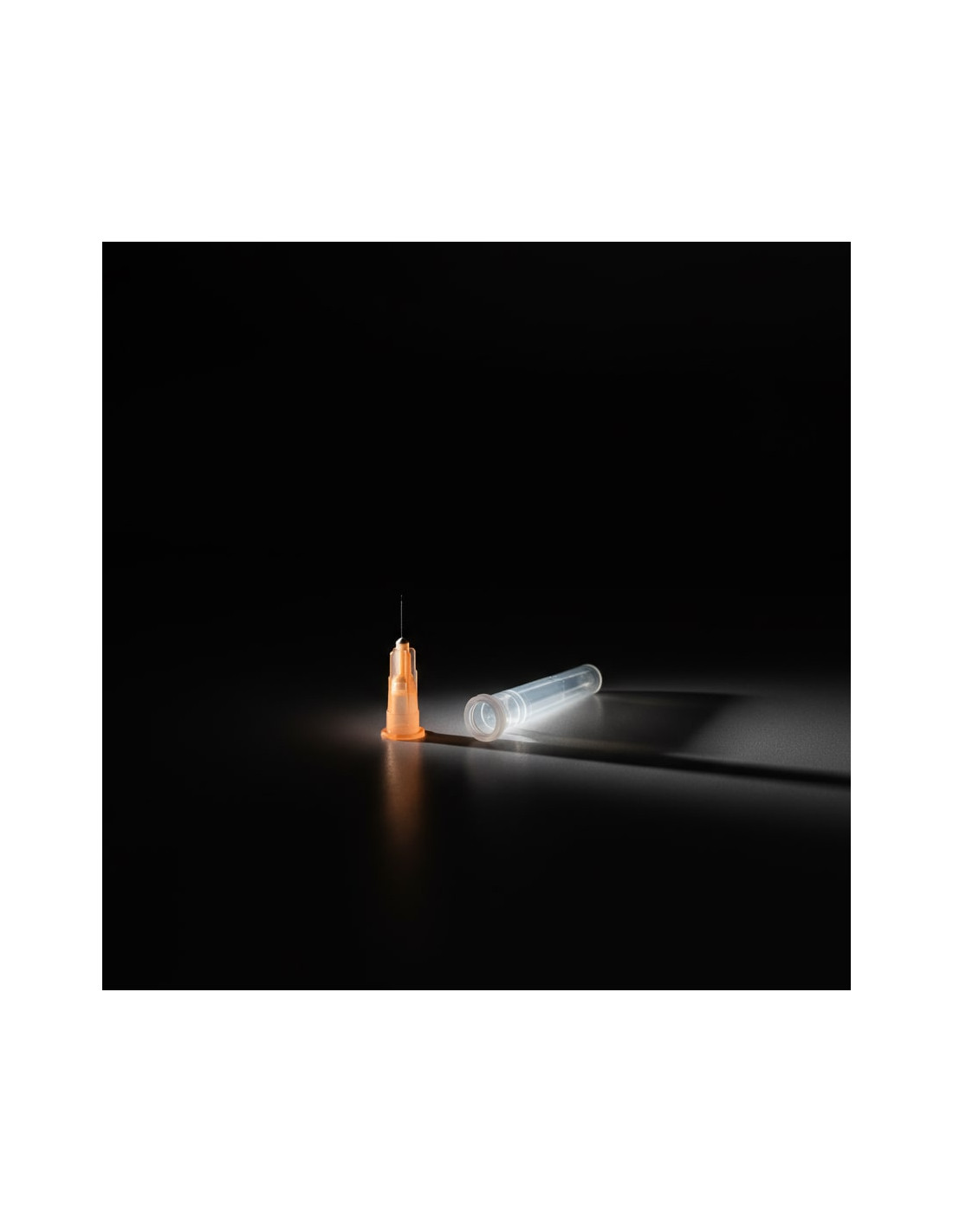 KIPIC 34G × 8 mm
Product image: KIPIC 34G × 8 mm. Dimensions according to current product documentation.
03 · System view
Why gauge alone does not determine flow
Gauge alone is not sufficient to determine flow or the required injection force. What matters is not only the outer diameter but the interaction of the entire needle–syringe–fluid combination.
1
Inner diameter and wall thickness
Two needles with a similar outer diameter can differ in their inner lumen. Wall design therefore affects the available flow cross-section.
2
Needle length
Under otherwise comparable conditions, a longer flow path can increase flow resistance. Length should therefore be considered separately from gauge.
3
Viscosity and flow rate
As viscosity increases, greater injection force may be required under otherwise comparable conditions. The desired flow rate also affects the force required.
4
Syringe geometry
Plunger and barrel geometry as well as friction within the syringe system also affect operating force. Needle and syringe should therefore be considered technically as a system.
Same outer contour, different lumen
ISO 9626 distinguishes, among other things, regular-wall, thin-wall and extra-thin-wall needle tubing. With the same outer diameter, wall thickness changes the internal flow cross-section.
Schematic, not to scale. No statement is made about the wall design of individual KIPIC variants.
No general conclusion from gauge alone:
Statements such as “34G flows X times worse than 30G” or a general assignment of particular gauge sizes to “low-” or “high-viscosity” products would go too far without product-specific measurement data.
04 · Needle length
4, 8, 13, 25 or 42 mm: consider needle length separately
Gauge and length are independent parameters. The required length depends on the intended professional workflow, the technique used and product-specific manufacturer information—not on the gauge number alone.
13 mm – available gauge sizes:
05 · Connection
Luer-Lock and connection compatibility
According to the manufacturer’s technical sheet, KIPIC needles have a Luer-Lock base. Before use, compatibility with the syringe being used should be checked against the relevant labelling and manufacturer information.
The term Luer-Lock alone should not be understood as a guarantee of universal compatibility. For hypodermic and intravascular Luer connections, ISO 80369-7 specifies requirements including connector design and functional performance.
Schematic, not to scale. Does not replace checking compatibility against labelling and manufacturer information.
Knowledge & Tools
Compare KIPIC sizes in the Explorer
Filter by gauge or length, compare variants technically and open specific products from there—without overloading the comparison table in this article.
06 · Before selection
What information should be checked before selecting a needle?
0 of 8 checked
All points checked. The instructions for use, labelling and professional assessment remain decisive.
View range: KIPIC needles and other needles for medical professionals
07 · FAQ
Frequently asked questions about 27G to 34G
What does 30G mean on a needle?
30G denotes the gauge size. For the KIPIC needles covered here, 30G corresponds to a documented outer diameter of 0.30 mm. Needle length is stated additionally and separately.
Is 34G thinner than 30G?
Yes. For KIPIC, 34G is documented with an outer diameter of 0.18 mm and 30G with 0.30 mm. Thinner does not automatically mean better or more suitable.
Does the same gauge always mean the same inner diameter?
No. Gauge or outer diameter does not fully describe the inner lumen. Wall thickness and construction can affect the actual inner diameter.
What role does needle length play?
Length and gauge are independent parameters. Length is stated in millimetres and must be assessed together with the specific variant, the intended professional workflow and manufacturer information.
Are KIPIC needles Luer-Lock?
According to the manufacturer’s technical sheet, the KIPIC needles covered here have a Luer-Lock base. Specific connection compatibility should nevertheless be checked for the product using its labelling and manufacturer information.
Is a higher gauge number generally better?
No. For the needles compared here, a higher gauge number indicates a smaller outer diameter. This is a technical parameter, not a quality ranking.
Sources
Sources and technical documentation
- Manufacturer documentationKIPIC Technical Sheet / FT-KIPIC Rev. 4 (including FT-KIPIC_ES_V4 and the English version).
- Manufacturer documentationKIPIC IFU; product labelling for KIPIC 33G × 13 mm; current manufacturer conformity/certification documents.
- Scientific literatureInjectability as a function of viscosity and dosing materials for subcutaneous administration – examines, among other factors, the effects of viscosity, needle inner diameter, needle length, wall thickness and syringe geometry on injection force.
- Scientific literatureLaboratory Study on Injection Force Measurement on Syringe and Needle Combinations – describes the influence of needle, syringe and fluid properties on the required force.
Note for medical professionals:
The technical information is provided to compare product characteristics. Selection and use depend on the intended purpose, instructions for use, manufacturer labelling, the product used and professional assessment. This article does not replace manufacturer instructions and does not contain treatment recommendations.