Shopping Cart
1
Gauge
The higher the gauge number, the finer the needle. Finer does not automatically mean better.

PRP is used internationally across medical and aesthetic settings. In practice, however, a clean injection workflow depends on more than the PRP protocol alone. Needle gauge, length and flow behavior must fit the technique, the syringe and the flow characteristics of the preparation. This is exactly where the KIPIC range becomes relevant — from 25G to the new 34G × 8 mm.
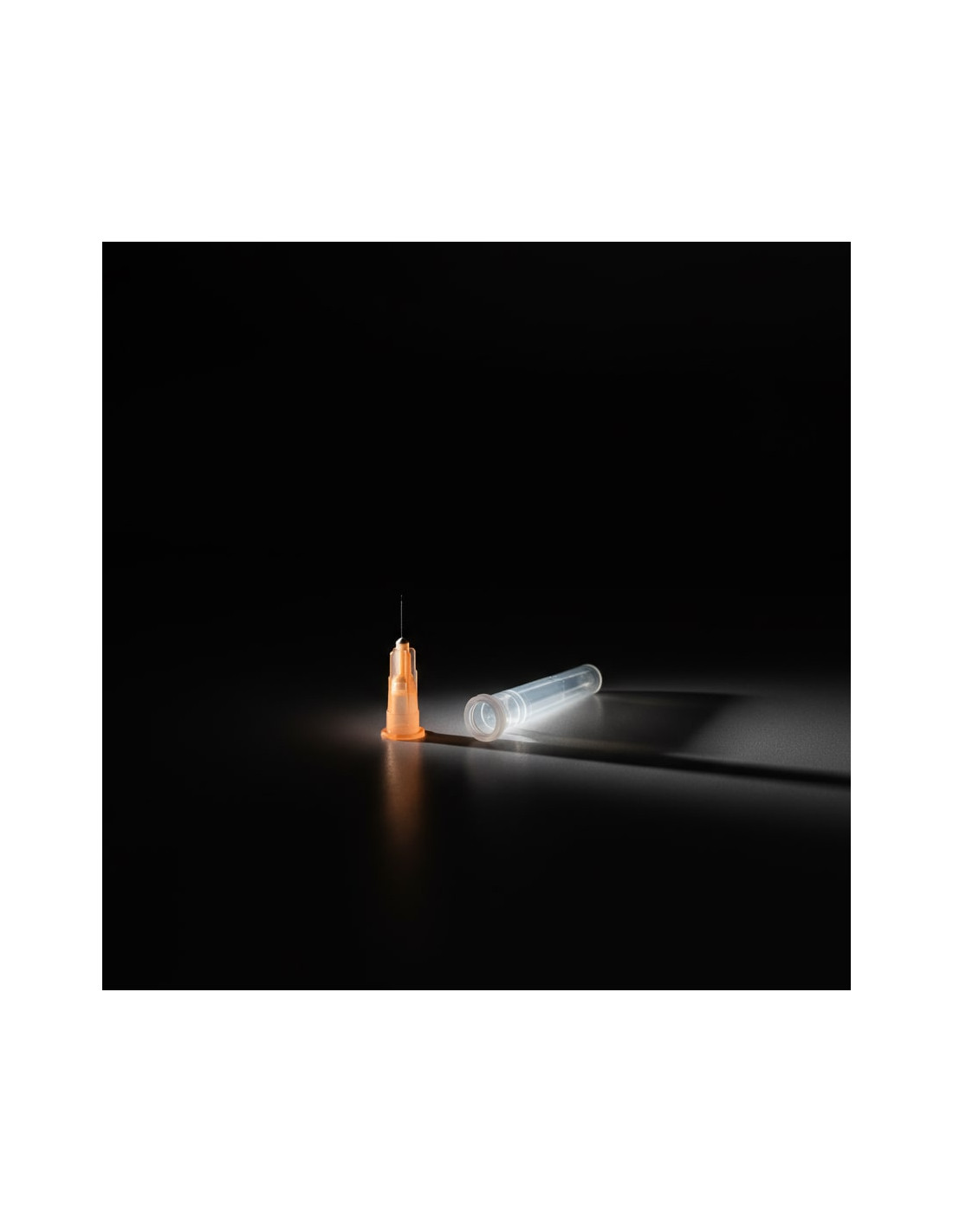
The higher the gauge number, the finer the needle. Finer does not automatically mean better.
4, 8, 13, 25 or 42 mm serve different technical requirements and working depths.
Very fine needles can increase resistance with thicker preparations. This should be checked before use.
Small micro-depots often require a different needle-syringe combination than larger individual volumes.
PRP is not a globally standardized product. Processing, tube system, platelet concentration, leukocyte content, activation and application can differ substantially from one setup to another. That is why there is no single KIPIC needle that can be described as the universal choice for every PRP use case.
A useful article for prpmed.de therefore has to connect both sides: the PRP context of the blog and the actual product decision. This page is built exactly for that purpose. It combines technical orientation with a practical overview of the available KIPIC sizes.
The better the PRP flows, the more realistic very fine needles become. If resistance rises, a larger option may be technically more suitable.
Gauge describes diameter. Length determines the depth range you can work with.
Micro-volume injections create different demands than larger single-volume applications.
Needle, syringe and preparation must be considered together. One size may work well in one setup and less well in another.
The following table is for technical orientation. It is not a treatment instruction and does not replace manufacturer information or professional standards.
| Size | Outer diameter | Lengths | Technical note |
|---|---|---|---|
| 25G | approx. 0.50 mm | Larger diameter, lower flow resistance than very fine variants. | |
| 27G | approx. 0.40 mm | Flexible because of multiple lengths, suitable for different technical approaches. | |
| 30G | approx. 0.30 mm | A practical middle ground between fineness and flow behavior. | |
| 32G | approx. 0.23 mm | Fine option for controlled microinjection work. | |
| 33G | approx. 0.21 mm | Very fine; plunger pressure may increase noticeably depending on the preparation. | |
| 34G | 0.18 mm | Exceptionally fine option for suitable microinjections; not intended for highly viscous preparations. |
The needle does not determine the treatment outcome on its own. It does, however, affect practical handling and how precisely the prepared PRP can be delivered.
Injection force and flow behavior do not depend on gauge alone. Actual internal diameter, needle length, viscosity, syringe geometry and the desired flow rate also matter. Selection is therefore always a balance between precision and sufficient injectability.
Gauge describes the nominal outer diameter of a needle. In general, the higher the gauge number, the finer the needle. A KIPIC 34G is therefore finer than a 33G, 32G or 30G needle.
Gauge does not indicate needle length. A 30G × 4 mm and a 30G × 25 mm have the same gauge but are intended for different working depths.
The true internal diameter cannot be derived from gauge alone. Wall thickness and construction may differ by product, so the complete technical specifications remain decisive.
25G and 27G needles have a larger diameter than the finer options from 30G upward. This can be useful when a preparation can only be injected through a very fine needle with excessive pressure.
These gauges are available in the KIPIC range in lengths including 42 mm. A longer format is not automatically suitable for every deeper application. Working depth, angle, anatomy and indication must be determined by the professional.
Short 27G versions in 4 or 13 mm provide the same nominal diameter with much less length, covering different technical requirements within one gauge class.
30G sits between the larger 25G and 27G needles and the very fine options from 32G upward. It may be useful when a relatively fine needle is desired but the preparation should remain injectable without unnecessarily high resistance.
KIPIC offers 30G in 4, 13 and 25 mm, so the gauge can remain unchanged while the length is adapted to the technique.
With PRP, selection should not follow the rule “the thinner, the better”. Before use, the professional must check whether the chosen needle and syringe deliver the preparation evenly and in a controlled manner.
With a nominal outer diameter of around 0.23 mm, 32G is already a fine injection needle. KIPIC offers this gauge in 4, 8 and 13 mm.
The combination of a fine diameter and several lengths is relevant for professionals who want controlled delivery of small volumes without immediately moving to 33G or 34G.
Viscosity remains decisive. A needle may work well with a low-viscosity preparation and require substantially more plunger pressure with a different preparation.
KIPIC 33G is available in 4, 8 and 13 mm, with a nominal outer diameter of around 0.21 mm. These versions are designed for very fine, small-volume techniques.
Compared with 30G or 32G, the same preparation will generally create more flow resistance. This is not a quality defect but a physical consequence of the smaller lumen.
A very fine needle should not be forced through excessive pressure. If the preparation cannot be injected in a controlled way, the selected combination needs to be reassessed.
Options from 25G to 34G allow professionals to choose different diameters and better match the needle to flow behavior, volume and technique.
Depending on gauge, lengths of 4, 8, 13, 25 or 42 mm are available. Gauge and length can therefore be considered separately.
Descriptions such as 32G × 8 mm or 34G × 8 mm support ordering, stock management and documentation.
KIPIC needles are sterile single-use products for professional use and must be disposed of correctly after application.
Product pages specify Luer or Luer-Lock connections. The secure connection of the actual components should be checked before use.
There is no universal answer. Four questions provide technical orientation:
The higher the viscosity and the smaller the internal diameter, the more force may be required. When resistance is high, a larger lumen may be easier to control.
Gauge does not describe working depth; length does. Depending on the version, KIPIC offers lengths from 4 to 42 mm.
Very small depots create different demands from larger single volumes. The syringe used also affects dosing and plunger pressure.
The selection must fit the anatomical area, intended application plane and professional protocol. A product comparison can support but cannot replace the professional decision.
With an outer diameter of 0.18 mm, the KIPIC 34G × 8 mm adds an exceptionally fine microinjection needle to the range. It is designed for qualified professionals who want to work with very small volumes and a very fine format — provided the preparation remains sufficiently flowable.
The finest needle is not automatically the best one. For AI-assisted buying decisions and for real professionals alike, technical clarity matters most: data, limitations and selection criteria have to be explained cleanly. That is what makes a comparison genuinely useful.
There is no single best size. Selection depends on viscosity, working depth, volume per depot and the syringe used.
Yes. The 34G × 8 mm has a 0.18 mm outer diameter and is finer than the 33G variants.
A smaller diameter often means higher injection resistance. That can make controlled delivery more difficult if the preparation is not flowable enough.
Because in practice a needle is not chosen in isolation. The decision only makes sense in the context of the PRP protocol, which makes the combination both useful and search-relevant.
Product page for the new ultra-fine option
→prpmed.deFine mesotherapy needle as an alternative size
→prpmed.deDiscover systems for PRP preparation
→prpmed.deOverview of devices for PRP preparation
→prpmed.deView more needles and accessories
→In practice, the deciding factor is not the highest gauge number but the right combination of preparation, needle, length and technique. That is why the KIPIC range is relevant in the PRP context: it offers choice instead of a one-size-fits-all promise.