
Shopping Cart
01
Why regulation is complex
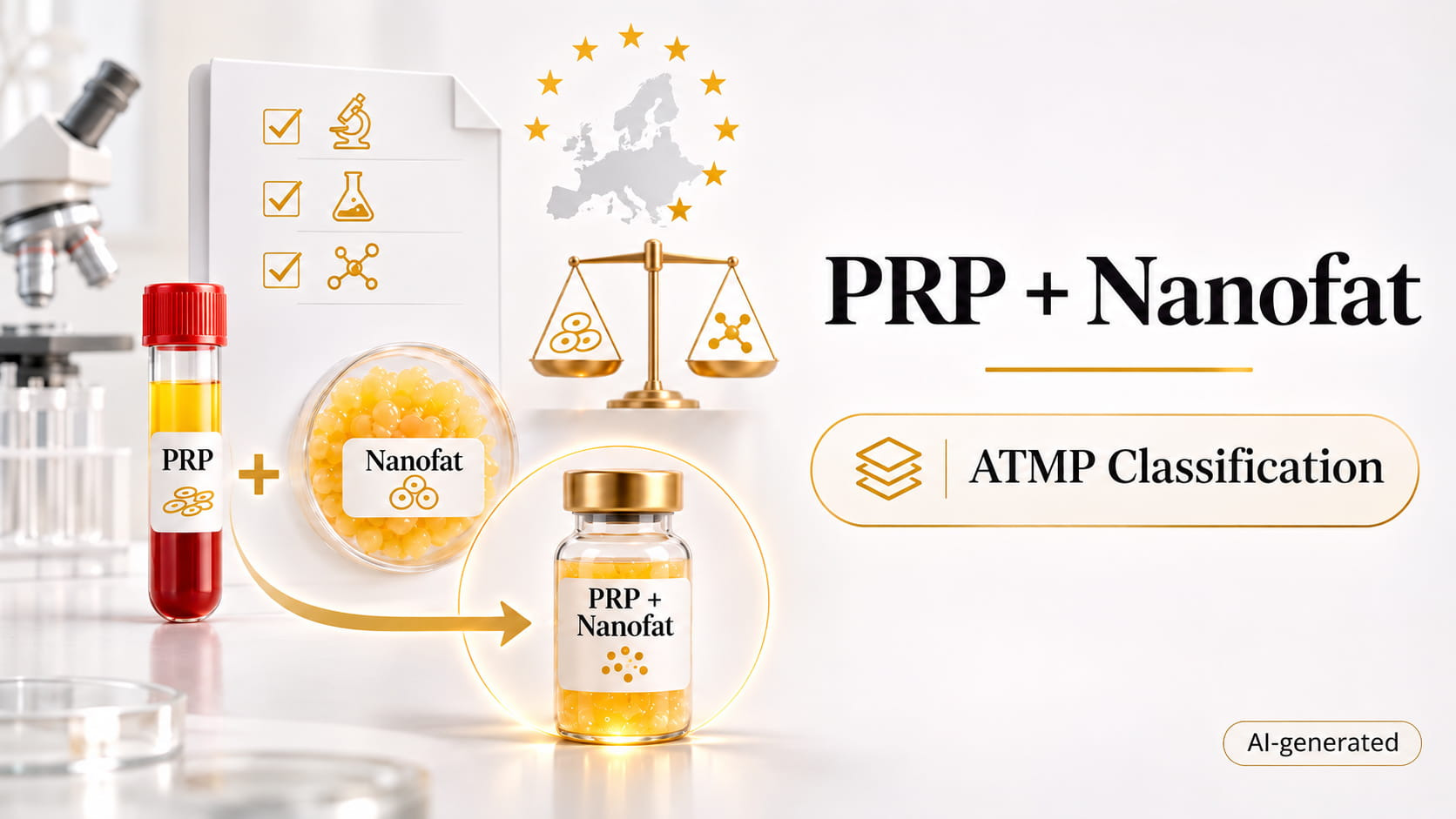
PRP and nanofat originate from different autologous tissues. Combining them does not create a product that can be classified solely by calling it autologous or mechanically processed.
The composition of the final preparation, processing effects and its intended biological function can all matter. The CAT decision of June 2026 illustrates why superficially similar preparations may be subject to different regulatory assessments. [B1] [B2]
02
What is PRP?
Platelet-rich plasma (PRP) is plasma derived from blood, generally with a higher platelet concentration than the starting blood. The term does not specify a uniform product: platelet and leukocyte counts and other blood components vary with the preparation method.
A systematic review found that only 44 of 132 clinical PRP studies characterised the PRP composition, while only 23 reported the leukocyte content. This limits comparisons between clinical findings. [S3]
In Germany, preparation and use of PRP may raise questions under medicinal-product and blood-product law. Classification depends on the product and its use. The CAT explicitly left the regulatory status of PRP used alone unresolved. [B1] [B5]
03
What is nanofat?
Nanofat usually describes mechanically processed autologous adipose tissue. Emulsification, repeated passage and filtration methods vary, influencing the cells, extracellular matrix and tissue fragments retained.
An early laboratory characterisation found no viable adipocytes in the particular nanofat sample examined, but reported stromal and CD34-positive cells. This does not establish the composition of all nanofat preparations. [S1]
Mechanically processed nanofat, enzymatically isolated stromal vascular fraction (SVF) and culture-expanded cells are not interchangeable biological or regulatory concepts. [S2]
Compare by:
Mechanical nanofat
Mechanical tissue processing
- Starting material
- Autologous adipose tissue (lipoaspirate)
- Processing
- Mechanical emulsification, passage and filtration, without enzymes
- Final preparation
- Tissue fragments, matrix and stromal cells; the particular preparation investigated had no viable adipocytes
- Regulatory question
- Annex I processes are generally not substantial manipulation; intended function still requires assessment. [B2]
Enzymatically obtained SVF
Enzymatic cell dissociation
- Starting material
- Autologous adipose tissue
- Processing
- Enzymatic digestion, e.g. with collagenase, followed by separation
- Final preparation
- Heterogeneous cell fraction without the original tissue architecture, containing several cell populations
- Regulatory question
- Enzymatic tissue dissociation may constitute substantial manipulation. [B3]
Cultured and expanded cells
Cell culture and expansion
- Starting material
- Cells isolated from SVF
- Processing
- Culture and expansion over multiple passages
- Final preparation
- A selected population of adherent stromal cells (ASCs)
- Regulatory question
- Expansion in culture is a typical example of substantial manipulation. [B3]
Schematic comparison only. Processing methods and final preparations may vary; no automatic legal classification follows.
04
Why combine PRP and nanofat?
The proposed rationale for combining PRP and nanofat is that platelets and their mediators may contribute different biological signals from stromal cells and matrix components in processed adipose tissue. This is a research hypothesis, not proof of synergy.
Whether any specific combination outperforms either component requires adequately controlled studies with fully characterised preparations and indication-specific outcomes. Laboratory markers alone cannot establish clinical tissue regeneration. [S5] [S8]
05
What did the CAT decide in 2026?
At its meeting of 17–19 June 2026, the CAT considered autologous PRP combined with mechanically processed autologous adipose tissue (nanofat) for refractory olfactory dysfunction. The adopted report classified this specific product as a tissue-engineered product under Article 2(1) of Regulation (EC) No 1394/2007. [B1]
Following comments from the European Commission, the CAT explicitly noted that this finding does not prejudge the regulatory status of autologous PRP used on its own. [B1]
Classification under Article 17 is scientific advice on the submitted product, not a marketing authorisation, a clinical efficacy finding or a recommendation to treat patients. The public minutes do not include all the product-specific reasons for the classification. [B1] [B10]
- Date not publishedClassification request
The applicant submits information on the product and intended use; the procedure is voluntary. [B10]
- 60-day periodAssessment and consultation
The CAT issues its scientific recommendation after consulting the European Commission, within the statutory period following receipt. [B2]
- 17–19 June 2026CAT meeting
The report was adopted: the submitted product met the TEP definition; the status of PRP alone was expressly reserved. [B1]
- 15 July 2026Minutes dated
EMA/CAT/194644/2026, section 4.4.1. The minutes do not contain the complete classification rationale. [B1]
- OngoingClassification summaries
The EMA publishes summaries of classification recommendations. [B10]
FindingScientific classification of the submitted product as a TEP.
ScopeThe specific product and intended use described to the CAT.
Not establishedNo marketing authorisation, efficacy proof or treatment recommendation.
06
What are ATMPs and tissue-engineered products?
Advanced therapy medicinal products (ATMPs) include gene therapy medicinal products, somatic cell therapy medicinal products and tissue-engineered products (TEPs). A TEP comprises engineered cells or tissues and is presented or used to regenerate, repair or replace human tissue. [B2]
Under Article 2(1)(c), cells or tissues may be engineered if relevant properties are substantially manipulated, OR if they are not intended to perform the same essential function in the recipient as in the donor. These are alternative criteria, not cumulative requirements. [B2] [B3]
Autologous origin does not by itself exclude ATMP classification. Under the Regulation, a product comprising both autologous and allogeneic cells or tissues is considered allogeneic. [B2]
07
When might the combination qualify as an ATMP?
Mechanical processing does not, by itself, rule out a TEP. Annex I lists cutting, grinding, centrifugation, cell separation and filtration among manipulations not considered substantial; nevertheless a different intended essential function can be decisive. [B2] [B3]
Assessment requires the actual cell and tissue constituents, effects of the process, essential function at the intended site and the exact intended use. Neither a procedure name nor a CE mark on processing equipment settles the product classification.
Enzymatic dissociation that disrupts tissue architecture can constitute substantial manipulation, but the use of an enzyme alone does not automatically establish the status of every final product. [B3]
The questions show how some legal criteria relate. They cannot classify an individual product.
Question 1
Does the finished product contain human cells or tissues?
Both viable and non-viable components require appropriate consideration. [B2]
Question 2
Were relevant properties substantially manipulated?
Annex I identifies certain operations that are not substantial; culture expansion or some forms of enzymatic dissociation may be substantial. [B2] [B3]
Question 3
Will cells or tissues perform the same essential function in the recipient as in the donor?
A different essential function is an alternative route to engineered status. [B2]
Question 4
Is the product presented or used to regenerate, repair or replace human tissue?
The intended use also matters to the TEP definition. [B2]
Additional check
Does the product contain exclusively non-viable cells or tissues?
An additional statutory distinction applies to exclusively non-viable cells or tissues. [B2]
Assessment note
The TEP definition may not apply
Without cells or tissues the TEP definition is not met, although other medicinal-product or device rules may remain relevant.
Assessment note
Neither engineered criterion appears to be met
This is not legal clearance; the function assessment itself requires expert judgement and other rules may apply.
Assessment note
Some TEP characteristics may be present
A product-specific assessment is needed. Article 17 advice or dialogue with competent authorities may help; the full CAT reasoning is not in the public minutes.
Assessment note
The stated TEP purpose is not present
Other categories, including somatic cell therapy products, may need to be considered depending on the intended mechanism.
Assessment note
A special exclusion may be relevant
With exclusively non-viable components, the main pharmacological, immunological or metabolic action must be considered. This is not general regulatory freedom.
Simplified educational pathway only. It is not an ATMP classification, legal advice or a substitute for review by competent authorities.
08
Why is no blanket classification possible?
Changes to processing, constituents, function or indication can alter the regulatory assessment. The table lists issues to evaluate—not binding classifications of other products. [B1] [B2]
| Scenario | Possible regulatory relevance | What must not be inferred |
|---|---|---|
| PRP alone | Medicinal- and blood-product rules may apply depending on the product and intended use. | Neither blanket ATMP status nor general exemption. |
| Mechanically processed nanofat alone | Manipulation and essential function can alter the assessment. | Mechanical processing does not guarantee it is outside ATMP rules. |
| PRP plus nanofat | One product for refractory olfactory dysfunction was classified as a TEP in 2026. | No automatic transfer to different preparations. |
| Enzymatically obtained cell fractions | Dissociation may be relevant to substantial manipulation. | Not every enzyme-derived fraction has the same status or authorisation. |
| PRP plus nanofat for a different purpose | Changes in intended function or indication may alter classification. | The CAT finding cannot simply be extended to aesthetics or other uses. |
The separate legal term “combined ATMP” requires, among other conditions, an integral medical-device component. Mixing PRP with nanofat is not automatically a combined ATMP. [B2]
Being outside the ATMP category also does not automatically make a preparation a medical device or merely a medical procedure. Other rules governing medicinal products, blood and tissues may apply. [B5] [B11]
09
State of clinical evidence
Biological plausibility, clinical efficacy, safety, standardisation and regulatory classification must be assessed separately. No peer-reviewed human study of the specific PRP–nanofat combination for refractory olfactory dysfunction was identified in the underlying research. A PRP-only trial does not answer that question. [S7]
Study or review includedNo combination study identifiedNot assessed here
| Indication | PRP alone | Nanofat-related evidence | PRP plus nanofat |
|---|---|---|---|
| Olfactory dysfunction | 1 RCTDuffy 2024 | Not assessed | Evidence gapNo human combination study identified |
| Cutaneous and burn scars | Not assessed | 2 reviews*Kuo 2026; Al-Sabri 2025 (some combinations) | 1 comparative studyBano 2025; n = 64 |
| Striae | Randomised studyLa Padula 2025: three study arms | Same studyNanofat arm | Same studyCombined arm |
- Olfaction · PRP only. Duffy 2024 investigated PRP alone; not the combination. [S7]
- Not assessed. This matrix summarises a selected bibliography, not all worldwide publications.
- Olfaction · combination. No peer-reviewed human study of the CAT-indicated combination was identified; classification does not assess clinical outcomes. [B1]
- Scar reviews. The reviews address heterogeneous nanofat approaches and in some cases combinations; they do not establish an independent general PRP benefit. [S6] [S9]
- Burn scars. Bano 2025 reports n=64, but the significance statements conflict with its table and baseline groups differ. [S5]
- Striae. La Padula reports histological findings, with inconsistent participant numbers across sections; conclusions are limited. [S8]
Additional evidence outside the matrix: lipofilling plus PRP in vulvar lichen sclerosus (Gutierrez-Ontalvilla et al. 2022) is not automatically mechanical nanofat. [S4]
La Padula et al.2025 · striae albae
A randomised single-blind study reports histological findings; the publication gives inconsistent participant counts. Short-term markers do not prove long-term clinical benefit. [S8]
Bano et al.2025 · burn scars
64 participants; the six-month table reports p=0.030 despite a nonsignificant conclusion. Groups also differed at baseline (p=0.045). [S5]
Kuo et al.2026 · systematic review
Five studies, 108 people. Certainty was low for short-term and very low for several longer-term scar outcomes. Not evidence for PRP–nanofat combinations. [S9]
Study limitations include small samples, heterogeneity of preparation, uncertain cell composition, insufficient platelet and leukocyte reporting, short follow-up and concomitant treatments. A review covering twelve heterogeneous nanofat studies does not establish an independent PRP benefit. [S3] [S6]
For safety, short follow-up and incomplete adverse-event reporting cannot exclude uncommon risks. Sampling, processing and administration involve different risk profiles.
Studies of PRP plus nanofat in other indications cannot be transferred directly to olfactory dysfunction. The CAT classification does not assess safety or efficacy. [B1]
A paper on nanofat and additional procedures that was subsequently retracted was excluded as evidence of efficacy. [S10]
10
What healthcare facilities should consider
A meaningful regulatory review requires a clear description of the finished product, preparation steps, cells and tissues, intended biological function and clinical purpose. Place of preparation and the professional status of the clinician do not themselves resolve classification.
The hospital exemption under Article 3(7) of Directive 2001/83/EC and section 4b AMG is subject to cumulative conditions, including non-routine, patient-specific preparation, quality standards, an individual medical prescription and use in a specialised healthcare facility under a physician’s responsibility. The PEI explains that such a facility can, in certain circumstances, also be a specialised medical practice. [B4] [B6] [B9]
In Germany, section 4b(3) AMG specifically addresses authorisation for supply to others; preparation, personal application and supply must be considered separately. Section 20d AMG contains a limited exception to certain permit requirements for specified physician activities with tissues; it is not a general ATMP exemption. [B6] [B7]
11
Conclusion
In 2026 the CAT classified one specific autologous PRP–nanofat product for refractory olfactory dysfunction as a tissue-engineered product. This was not an authorisation and it is not a rule for all combinations. [B1]
The available clinical evidence is too heterogeneous to support a general therapeutic benefit from adding PRP to nanofat. Regulatory assessment and evaluation of clinical outcomes remain separate questions.
12
Frequently asked questions
Is PRP plus nanofat always an ATMP?
No. Product composition, manipulation, essential function and intended use require a case-specific assessment. [B1] [B2]
Did the EMA authorise PRP plus nanofat in 2026?
No. The CAT issued a scientific classification for one submitted product, not marketing authorisation. [B1]
Does the decision classify PRP alone as an ATMP?
No. The minutes expressly reserve the regulatory status of autologous PRP used alone. [B1]
Is mechanically processed nanofat always exempt?
No. Even non-substantially manipulated tissue may be relevant if its intended essential function changes. [B2]
Is enzymatic SVF the same as nanofat?
No. They differ in processing, composition and potentially regulatory classification. [B3] [S2]
Does CAT classification prove efficacy or safety?
No. Efficacy and safety need separate indication-specific clinical evidence. [B10]