
Shopping Cart
Veterinary medicine · Orthopaedics · Evidence
PRP in dogs: What is known about its use for osteoarthritis and orthopaedic disorders?
Platelet-rich plasma is being studied in veterinary orthopaedics as an adjunctive procedure. Current data suggest possible benefits in some dogs, but do not justify general claims of healing.
Schematic PRP preparation
CentrifugationSeparation of blood components
Simplified illustration, not to scale and not a treatment protocol.
Autologous procedureThe prepared plasma is obtained from the blood of the dog being treated.
Not a standard solutionSuitability depends on the diagnosis, clinical findings and treatment goal.
Limited evidenceStudies differ markedly in preparation, protocol and outcome measurement.
Assessment
Pain in dogs can have many causes
Lameness, reluctance to move or difficulty getting up may be caused by osteoarthritis, joint injuries, tendon or ligament disease, or other orthopaedic changes. A veterinary diagnosis is therefore required before treatment.
Alongside medication, physiotherapy, weight management and surgery, platelet-rich plasma, or PRP, is also used. PRP is not a stand-alone standard treatment for every type of pain, but may be considered as an adjunct in selected cases.
What is platelet-rich plasma?
After blood collection, the blood components are separated by centrifugation. This produces a plasma fraction with a higher platelet concentration than the original blood. Platelets contain signalling substances involved in inflammatory and repair processes.
Potential fields of use01 02 03
Where is PRP being studied in dogs?
Most research concerns musculoskeletal disease. Any statement about a specific benefit must still be assessed separately for each indication.
Osteoarthritis and joint problems
Some studies report changes in pain, lameness or limb loading. It has not been shown that PRP stops osteoarthritis or reliably restores already damaged cartilage.
Tendon and ligament injuries
Research has included Achilles tendon injuries and treatment in the context of cruciate ligament disease. Small case numbers and combined therapies make it difficult to attribute effects clearly to PRP.
Adjunct to orthopaedic surgery
PRP has also been used during certain bone and joint operations. Evidence of biological activity does not automatically mean a lasting functional benefit.
Evidence
What can currently be stated with reasonable caution?
Research does not provide a simple yes or no. Many studies are small, use different PRP preparations and assess outcomes in different ways.
PossiblePain, lameness or mobility may temporarily change in some dogs.
UnclearWhich preparation, dose and number of applications are most suitable.
Not establishedThat PRP reliably renews destroyed cartilage, stops osteoarthritis or replaces necessary surgery.
Procedure
How may a PRP procedure in a dog be carried out?
The exact workflow depends on the diagnosis, anatomical site, preparation system and veterinary protocol. There is no single universal method.
1
Diagnosis
Clinical examination and, depending on the findings, further diagnostics such as imaging or gait analysis.
2
Blood collection
Collection of a defined blood volume in accordance with the selected preparation protocol.
3
Preparation
Centrifugation and collection of the intended plasma fraction under controlled hygienic conditions.
4
Administration
Depending on the indication, placement into a joint, near a tendon or in a surgical area. Image-guided placement may be required.
5
Aftercare
Individual instructions regarding loading, exercise, analgesia and physiotherapy.
Technical preparation
Tubes and centrifuges are not freely interchangeable
The properties of a PRP preparation do not depend on a tube or centrifuge alone. The full protocol, rotor radius, relative centrifugal force, run time, starting volume and intended purpose of the respective product are relevant.
For professional usersManufacturer information and instructions for use take priority. Parameters must not be transferred from one system to another on the basis of rotational speed alone.

Preparation component
PRP tubes
PRP tubes differ in material, additives, separation system and intended preparation protocol. Selection should not be based on filling volume alone.
View PRP tubes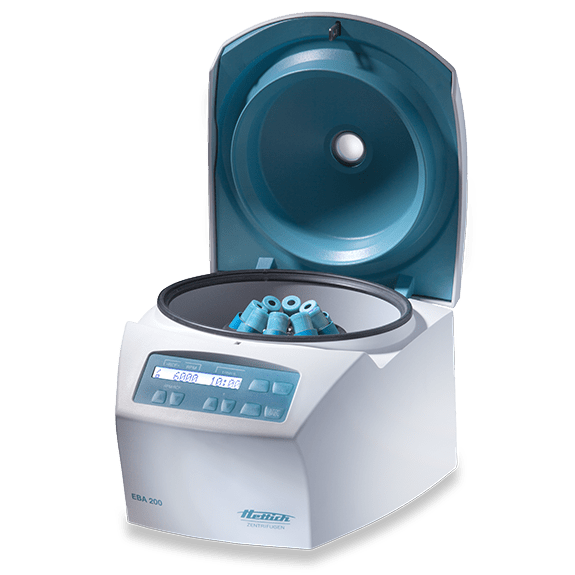
Medical-device centrifuge
Hettich EBA 200 MD
A compact centrifuge for professional use. Compatibility with the selected tube system and correct implementation of the specified RCF protocol are decisive.
View Hettich EBA 200 MDNote on veterinary use: The products shown here are described solely as technical components of PRP preparation. This is not a recommendation for a specific treatment in animals. Whether a product may be used for an intended veterinary application depends on its intended purpose, instructions for use and the applicable professional and legal requirements.
Safety
Which risks and limitations should be considered?
Because autologous PRP is prepared from the treated dog’s own blood, intolerance to donor material is not the main concern. The procedure is nevertheless not risk-free.
Possible temporary reactions
Pain, local irritation or temporarily increased lameness may occur after an injection. Duration and intensity vary between animals.
General procedural risks
There are also risks associated with blood collection, joint injection and, where applicable, sedation. Inadequate aseptic technique can result in infection.
- Pre-existing conditions and current medication must be considered beforehand.
- PRP does not mechanically stabilise an unstable joint.
- PRP does not replace necessary diagnostics or comprehensive osteoarthritis management.
Frequently asked questions
PRP in dogs: brief answers
Can PRP cure osteoarthritis in dogs?
No. Osteoarthritis is a chronic joint disease. PRP is being studied for its possible effects on symptoms and function. Reliable restoration of an already damaged joint has not been clinically demonstrated.
How quickly might a change occur?
This cannot be predicted reliably. The timing, magnitude and duration of possible changes vary considerably between dogs and studies.
Is a single injection enough?
Both single-application and multiple-application protocols are used. There is currently no generally accepted standard for the number or interval of applications.
Can PRP replace cruciate ligament surgery?
PRP does not mechanically stabilise an unstable knee. Whether surgery is required depends on the findings, joint stability and other individual factors.
Is PRP suitable for every dog?
No. The diagnosis, general health and treatment objective are decisive. Other conservative or surgical options may be more appropriate for some conditions.
Balanced assessment
A possible adjunct, but not a proven replacement for established procedures
PRP is a biological procedure used in veterinary orthopaedics and continues to be studied. Current research indicates possible symptomatic benefits in some dogs. Small study groups, differing preparation methods and methodological weaknesses limit the strength of the conclusions.
It should therefore not be used with the expectation that it will rebuild damaged cartilage or reliably stop progressive osteoarthritis. Following veterinary assessment, it may be considered as an adjunct within a broader treatment plan.
Literature references from the original article
- The effect of platelet-rich plasma on bone healing in dogs undergoing a high tibial osteotomy.
- Platelet-rich plasma in an animal long-bone model: an analysis of basic scientific findings.
- Regenerative medicine for equine musculoskeletal disease. Findings from equine medicine cannot automatically be transferred to dogs.
This article provides general professional information. It does not replace a veterinary examination, diagnosis or individual treatment decision. The retailer neither recommends nor advises against a treatment.