Shopping Cart
Technical information for PRP and PRF professionals
Density Platelet Gel PRP tubes without additives: PRF protocols and centrifugation explained
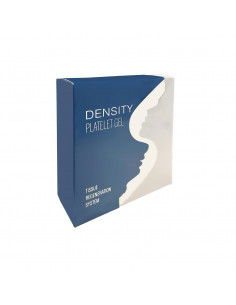
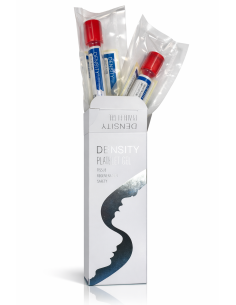
Density Platelet Gel PRP tubes are 9 ml glass tubes without added anticoagulant and without separation gel. For medical professionals, this open configuration is technically relevant: it allows different anticoagulant-free preparation approaches but does not define a ready-made PRP or PRF protocol. This article explains the options and the L-PRF, A-PRF and A-PRF+ parameters described in the literature.
✓ no anticoagulant✓ no separation gel✓ glass tube✓ 9 ml
What are Density Platelet Gel PRP tubes?
Density Platelet Gel is the product name of a tube system for processing autologous blood components. The version offered by prpmed.de is a 9 ml glass tube without added anticoagulant and without separation gel. It therefore differs technically from PRP tubes in which citrate delays coagulation and a separator gel forms a physical barrier between blood fractions after centrifugation.
MaterialGlass
Volume9 ml
Anticoagulantnot added
Separation gelnot included
The key point: “Platelet Gel” in the product name must not be confused with separator gel inside a blood collection tube. According to the product description, the Density tube itself contains no gel barrier.
What is the advantage of a glass tube without additives?
The main advantage is not an automatically “better” final product, but the lower degree of predefinition of the preparation pathway. Neither a prefilled anticoagulant nor a gel barrier determines at blood collection how coagulation and fraction separation must proceed. This creates additional technical options, but also requires a suitable, documented protocol.
01 · Anticoagulant-free
PRF-oriented protocols become possible
Classic L-PRF, A-PRF and A-PRF+ methods work without externally added anticoagulant. Blood collection and centrifugation start therefore have to match the timing of the respective protocol.
02 · No gel barrier
Fractions remain manually accessible
After centrifugation no polymer gel separates the layers. This can allow targeted collection of a selected fraction, but makes processing more dependent on technique, experience and protocol.
03 · Glass surface
Relevant for solid PRF matrices
Published A-PRF and A-PRF+ protocols have, among other setups, used glass tubes without externally added anticoagulant. Glass must therefore not be equated with additive-free plastic.
04 · Protocol-open
More flexibility, not a free-form recipe
Whether an anticoagulant may be added later or which target products are intended must be covered by the current IFU, intended purpose and professionally validated processes.
Important: “Without additives” does not mean “biologically neutral”. Tube material, surface, rotor angle, rotor radius, RCF, run time and braking can influence the fibrin structure and cell distribution.
What does “without anticoagulant” mean?
Anticoagulants such as sodium citrate are used in many PRP systems to delay coagulation during processing. In a tube without added anticoagulant, this step is not chemically delayed. Timing, centrifugation and the workflow are therefore closely linked to the intended protocol.
This does not automatically mean that an anticoagulant-free system produces “better PRP”. PRP and PRF comprise different preparation methods and product classes.
Are Density Platelet Gel tubes PRP, PRF or CGF tubes?
The tube alone does not define the final platelet concentrate. PRP, PRF and CGF should not be used synonymously. Tube design, RCF, run time, number of centrifugation steps and the fraction collected together determine the actual preparation.
Which PRF protocols are described in the literature?
For glass tubes without externally added anticoagulant, solid PRF matrices are particularly relevant. The table shows published literature parameters and, next to them, a purely mathematical RCF conversion to the maximum radius of the Hettich EBA 200. It is explicitly not a Density or Hettich instruction for use.
| Protocol | Published reference | Time | Tube material in relevant literature | Calculated EBA 200 at rmax ≈ 86.0 mm | B1 assessment for Density |
|---|---|---|---|---|---|
| L-PRF | RCFmax 653 × g; RCFclot 408 × g | 12 min | glass or protocol-specific coated tube | ≈ 2,606 rpm | highly relevant, but not validated for Density |
| A-PRF | RCFmax 276 × g; RCFclot 193 × g | 14 min | glass in published protocols | ≈ 1,694 rpm | highly relevant, but not validated for Density |
| A-PRF+ | RCFmax 208 × g; RCFclot 145 × g | 8 min | glass in published protocols | ≈ 1,471 rpm | highly relevant, but not validated for Density |
| i-PRF | approx. 60 × g | 3 min | typically additive-free plastic | ≈ 790 rpm | calculated value must not be transferred to Density glass |
| CGF | 692 / 547 / 592 / 885 × g | 2 / 4 / 4 / 3 min | glass in cited 33° study | ≈ 2,683 / 2,385 / 2,481 / 3,034 rpm | dynamic and device-dependent; not a setting instruction |
No trial recipes: Literature values are not manufacturer approvals. The IFU, intended purpose, device approvals and a validated process remain decisive.
What changes without separation gel?
In PRP tubes with separator gel, the gel forms a physical barrier between blood fractions during centrifugation. According to the current product description, Density Platelet Gel PRP tubes do not contain this barrier. The layers must therefore be identified without a gel boundary and collected according to the intended protocol.
| Feature | Density Platelet Gel | Classic PRP tube with citrate + separation gel |
|---|---|---|
| Anticoagulant | not added | often sodium citrate |
| Separation gel | not included | present |
| Gel barrier after centrifugation | No | Yes, depending on system |
| Fraction collection | without physical gel boundary, protocol-dependent | technically separated by gel barrier |
| Coagulation management | no added anticoagulant | coagulation delayed by anticoagulant |
How were the literature RCF values converted for the EBA 200 MD?
Hettich specifies a 33° integrated 8-place angle rotor for the EBA 200, with a maximum of 6,000 rpm and 3,461 × g at 8 × 10 ml. From these maximum values, a maximum effective radius of about 86.0 mm can be derived for the mathematical conversion. This is a calculated value from manufacturer data, not a separately published Hettich radius specification.
RCF = 1.118 × 10⁻⁵ × r(cm) × RPM²RPM = √[RCF ÷ (1.118 × 10⁻⁵ × r)]
The reference position of the RCF is critical. Studies sometimes distinguish between RCFclot and RCFmax. Where available, the published RCFmax values were used for the device conversion.
The calculated RPM values are not setting instructions. Rotor, adapter, actual tube dimensions, braking and clot position change the real RCF distribution.
When is a tube without anticoagulant and separation gel technically relevant?
Such a tube is particularly relevant when a professionally defined preparation pathway without a predefined anticoagulant and without a gel barrier is required. The advantage is not a generally “better” result, but technical openness. Before use, intended purpose, current IFU, regulatory status, centrifuge compatibility and the specific preparation protocol should be checked.
Frequently asked questions about Density Platelet Gel PRP tubes
Do Density Platelet Gel PRP tubes contain separation gel?
No. According to the current product description, the Density tubes are supplied without separation gel. “Platelet Gel” is part of the product name and does not mean that separator gel is present in the tube.
Do Density tubes contain sodium citrate or heparin?
According to the product description, they contain no added anticoagulant. The current IFU and manufacturer documentation remain decisive for every application.
Are Density Platelet Gel tubes PRP or PRF tubes?
The tube alone does not define the final product. PRP and PRF are classified by the complete preparation process and the properties of the resulting concentrate.
Can I use any centrifuge?
No. Tube dimensions, rotor and adapter, permitted speed or RCF and the intended protocol must be compatible.
Which RCF or RPM is correct for Density Platelet Gel?
No universal value can be derived from the product name. The current IFU or an approved product protocol is decisive.
Is 2,606 rpm for L-PRF on the EBA 200 MD an approved protocol?
No. It is a mathematical back-calculation of the published RCFmax target of 653 × g using a radius of about 86 mm derived from Hettich maximum data.
Why not simply prepare i-PRF in Density glass at about 790 rpm?
The original i-PRF method was described at about 60 × g for 3 minutes, typically in additive-free plastic tubes. Glass affects coagulation differently, so the calculated value is not a 1:1 transfer.
What is the main difference from PRP tubes with citrate and separation gel?
Density contains neither added anticoagulant nor a physical gel barrier. The workflow therefore differs fundamentally from systems with citrate and separator gel.
View Density Platelet Gel PRP tubes
Product details, current availability and pack information are available on the product page.
Sources and further information
- prpmed.de: Density Platelet Gel / PRF-PRP glass tubes without anticoagulant or separation gel – product page; current manufacturer documentation and IFU remain decisive.
- Hettich: EBA 200 – official product data: 6,000 rpm, 3,461 × g, 8 × 10 ml and 33° angle rotor.
- Castro AB et al.: Impact of g force and timing on the characteristics of platelet-rich fibrin matrices.
- El Bagdadi K et al.: Reduction of relative centrifugal forces increases growth factor release within solid platelet-rich-fibrin (PRF)-based matrices.
- Miron RJ. et al.: Injectable platelet rich fibrin (i-PRF): opportunities in regenerative dentistry?.
- Aizawa H et al.: Quantitative Near-Infrared Imaging of Platelets in Platelet-Rich Fibrin Matrices.
Editorial note: This article is intended for medical professionals and describes technical relationships and parameters from the scientific literature. Literature protocols, mathematically transferred RCF/RPM values and published third-party systems are not validated manufacturer protocols for Density Platelet Gel or Hettich EBA 200 MD. The information does not replace the current IFU or validation of the actual preparation process.