


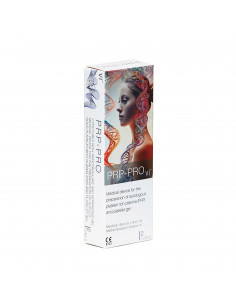
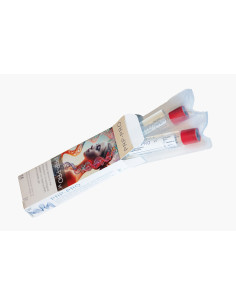
PRP tubes | without anticoagulant | PU 10 pieces
Density PRP/PRF Tubes | without anticoagulants | VPE 10 pcs.
PRP tubes | without anticoagulant | PU 10 pieces
Density PRP/PRF Tubes | without anticoagulants | VPE 10 pcs.

PRF/PRP Glass Tubes without Anticoagulant or Separation Gel | 9 ml | PU 10 tubes

Glass tubes for PRF/PRP applications without anticoagulants. Free of separation gel and additives, suitable for various PRF protocols in all medical fields as well as for PRP procedures.

These tubes contain no gel and no anticoagulants.

Contents: 10 empty PRF/PRP tubes

100104
immediately available
€96.00
incl. tax, plus shipping Shipping excluded | Delivery time 2 - 3 days within Germany* | Abroad may vary

 
Article 100104 · for trained medical professionals

Density Platelet Gel PRP Tubes: three preparation pathways, one glass tube

Density Platelet Gel is a 9 ml glass tube supplied without a prefilled anticoagulant and without separation gel. It is intended for the preparation of PRP or PRF. Unlike many conventional PRP tubes, the workflow is not predetermined by citrate and gel already inside the tube.

The reason to choose Density is not that it contains “more” – but that less is predetermined. It opens three pathways: PRF without anticoagulant, PRP with heparin, or PRP with citrate.
no prefilled anticoagulant no separation gel glass · 9 ml PRP or PRF pack of 10
Quick overview

One tube, three pathways

PRF · no anticoagulantPRP · HeparinPRP · Citrate

The tube remains the base – the selected workflow defines the direction.

9
9 ml
Ø
Glass
No gel
3
3 workflows
Why Density?

Why can an “empty” tube be the better choice?

For medical professionals, the benefit is not an additional ingredient but the ability to choose a defined workflow. Density is supplied without a prefilled anticoagulant and without a gel barrier. The same tube can therefore be used for several preparation pathways possible.

01

Three pathways instead of one fixed system

Without anticoagulant for PRF, with heparin for PRP, or with citrate for PRP. These three variants are clearly provided for.

02

No gel barrier

After centrifugation, blood fractions are not separated by a polymer gel. Fraction collection remains part of the defined workflow.

03

One tube type for different protocols

For practices using several PRP/PRF workflows, a non-prefilled tube can simplify product selection.

04

A clear choice rather than a blanket “better”

If a prefilled citrate/separation-gel system is required, another PRP tube may be more suitable. Density is for users who specifically do not want that predefined setup.

Density is especially relevant when …

  • You prepare PRF without added anticoagulant.
  • You prepare PRP with heparin or citrate according to the intended protocol.
  • You do not require a physical gel barrier between fractions.
  • You want a 9 ml glass tube as a flexible starting point for several defined workflows.

Another system may be more suitable when …

  • Your workflow requires an anticoagulant that is already prefilled.
  • You want a gel barrier for simplified fraction separation.
  • You only use one fixed, closed PRP workflow.
Three pathways with Density

PRF without anticoagulant · PRP with heparin · PRP with citrate

The following parameters show the three preparation pathways and how the tube is prepared for each workflow.

Pathway 1

PRF without anticoagulant

Collect blood directly into the untreated tube. Natural coagulation is part of the process.

Blood volume
8–9 ml
Start centrifugation
within 60 seconds
A-PRF+
1,300 rpm · 8 minutes
i-PRF
700 rpm · 3–4 minutes
i-PRF processing
within 15 minutes
Pathway 2

PRP with heparin

Before blood collection, prepare the empty tube with heparin.

Heparin
Heparin sodium 500 IU/ml
Dose
18 IU directly into the empty tube
Blood volume
8–9 ml
Centrifugation
1,200 × g · 7 minutes
Result
approx. 4–5 ml PRP
Pathway 3

PRP with citrate

As an alternative, PRP preparation with trisodium citrate is possible.

Citrate
Trisodium citrate 3.2% or 3.8%
Mixing ratio
1 part citrate : 9 parts blood
Example
0.89 ml citrate + 8 ml blood
Centrifugation
1,200 × g · 7 minutes
Result
approx. 4–5 ml PRP
Important: The values above are based on the supplied product documentation. They are not a general recommendation for other tubes or centrifuge systems. The current IFU, centrifuge compatibility, rotor geometry and local requirements remain decisive.
Product profile

Density Platelet Gel PRP Tubes at a glance

MaterialGlass
Volume9 ml
Separation gelnot included
Anticoagulant when suppliednot prefilled
PurposePRP or PRF
Pack contents10 tubes
Article number100104
ClassificationClass IIa medical device
The purchase decision

Density or a conventional prefilled PRP tube?

Both concepts have their place. The key question is which setup fits your workflow.

FeatureDensity Platelet Gel PRP TubesPrefilled PRP system
Anticoagulantnone prefilled when suppliedpredetermined by the system
Separation gelNooften present, system-dependent
PRF without anticoagulantprovided fornot the same workflow in a citrate-filled system
PRP with heparinpossibleonly if the respective system allows it
PRP with citratepossibletypically predefined
Workflow flexibilitythree pathwaysmore strongly defined by the prefilled system
FAQ

Frequently asked questions about Density Platelet Gel PRP Tubes

Does Density Platelet Gel PRP Tubes contain an anticoagulant when supplied?
No. The tube is supplied without a prefilled anticoagulant. For PRP it can be prepared with heparin or citrate; for PRF it is used without anticoagulant.
Can heparin be used?
Yes. Heparin sodium 500 IU/ml at a dose of 18 IU per tube is provided for the PRP variant.
Can citrate be used?
Yes. Trisodium citrate 3.2% or 3.8% is provided at a ratio of 1 part citrate to 9 parts blood.
Can PRF be prepared without anticoagulant?
Yes. A PRF pathway without anticoagulant is provided; centrifugation should start within 60 seconds after blood collection.
Does the tube contain separation gel?
No. Density Platelet Gel PRP Tubes is supplied without separator/separation gel.
How much PRP is typically obtained?
For the anticoagulated PRP variants, approximately 4–5 ml PRP is stated at 1,200 × g for 7 minutes.
Can I transfer the rpm values to any centrifuge?
Not automatically. RPM and RCF depend on rotor geometry. Compatibility and the current instructions for the centrifuge being used must be checked.

Why choose Density?

Because medical professionals do not always need a tube that predetermines the entire workflow. Density Platelet Gel PRP Tubes provides a 9 ml glass starting point for three pathways possible: PRF without anticoagulant, PRP with heparin, or PRP with citrate. That choice is the core product benefit.

For trained medical professionals only. Use only in accordance with the current IFU, intended purpose, labelling and applicable regulatory requirements.

Basis of this description: supplied product documentation. If information differs, the current manufacturer IFU takes precedence.
Features
Risk class IIa, without anticoagulant and separating gel. Approximately 4 / 4.5 ml of PRP can be obtained in each PRP tube.

GPSR – General Product Safety Regulation

Responsible Economic Operator according to GPSR:

Xenoderm Srl

Trav. Castagno snc 

Via Tricino

84018 Scafati SA 

Italy


Tel. : +39 081 856 8081

Tel. : +39 366 6813148


Email: [email protected]

Customers who bought this product also bought:

Product added to wishlist
Product added to compare.
group_work Cookie consent