Shopping Cart
Practice economics · PRP · Updated September 2026
PRP ROI in clinical practice: calculate break-even, contribution margin and profitability properly
Whether PRP pays for itself is not determined by the purchase price of the centrifuge. What matters is the actual contribution margin per completed session, the number of appointments that really take place, and a calculation that includes time, cancellations, tax and billing.
Bottom line: A high fee per PRP session can still produce a weak ROI if consumables, clinician time, room time, acquisition costs, no-shows and added fixed costs are ignored. Conversely, a modest case volume may be viable when the workflow is standardized and creates little idle time.
1
Revenue is not profit
For break-even, use the contribution margin per session actually completed, not the list price.
2
Utilization beats equipment price
A cheaper centrifuge cannot rescue a workflow with few appointments, frequent cancellations or long changeover times.
3
Separate evidence from demand
Health-economic studies do not automatically tell you what an individual clinic will earn.
4
Clarify billing before launch
Billing rules, reimbursable expenses and VAT should be checked before setting prices and workflows.
5
Recalculate with real data
After the first 10–20 cases, replace planning assumptions with measured times, costs and cancellation rates.
1. The key mistake: ROI is not the same as cost-effectiveness
PRP publications often use terms such as “cost-effective”, QALY or ICER. These analyses usually take a health-system or payer perspective – for example, whether PRP generates sufficient health benefit per euro compared with an alternative. A 2020 knee osteoarthritis analysis estimated that, from a payer perspective, the total PRP treatment cost would need to remain below US$1,192.08 over 12 months to be cost-effective versus hyaluronic acid or saline under that model.6 This is not a fee recommendation for a clinic and says nothing about its contribution margin.
For clinic economics, the question is simpler: how much remains after the directly caused costs of a completed session, how many such sessions actually occur, and what additional fixed costs must be covered? Only then does it make sense to discuss break-even or payback.
Contribution margin per session
realized revenue − materials − time cost − other variable costsMonthly operating contribution
completed sessions × contribution margin − added fixed costsCapital break-even
initial investment ÷ positive contribution margin per sessionInteractive PRP ROI calculator
A simplified cash model for practice planning. Presets are worked examples, not fee recommendations.
Contribution margin per session–
Completed sessions/month–
Monthly operating contribution–
Break-even sessions–
Payback in months–
Simplified 12-month cash ROI–
Important: this calculator does not fully model depreciation, financing, income tax, overhead allocation or opportunity costs. If VAT applies, enter the revenue that remains after VAT payable. A negative monthly contribution means there is no payback in that scenario.
2. Costs that belong in a credible PRP calculation
A useful model separates one-off investment, variable costs and incremental fixed costs. Counting only the PRP tube and needle almost always understates the real session cost.
Initial investment
Centrifuge, rotor or required accessories, opening stock, workstation setup and any training or validation effort.
Consumables
PRP tubes, phlebotomy supplies, syringes, needles, antisepsis, sterile single-use items and any other case-specific materials.
Clinician and staff time
Consent, blood draw, preparation, application, documentation and pre/post procedure work. Occupied time matters, not just injection time.
Room and equipment time
Treatment room, centrifuge run and blocked capacity. In a small team, this bottleneck may cost more than the consumables.
Cancellations and friction
No-shows, late cancellations, delayed starts, queries, scheduling and non-billable follow-up reduce productive utilization.
Incremental fixed costs
Maintenance, quality assurance, software, marketing, insurance shares or other costs that arise specifically because the service is added.
3. The metric that often tells you more than the fee per session
For capacity planning, contribution margin per occupied treatment hour is often more informative than revenue per session. Two services with the same fee may have very different economics if one ties up twice as much clinician and room time. Use this metric for internal resource planning – not to choose medical indications or treatment intervals according to profitability.
Do not confuse the two: An economically efficient workflow is not a medical reason to provide PRP. Indication, frequency and technique must be clinically justified first; only then should the workflow be optimized economically.
4. What the evidence can – and cannot – tell you about ROI
The literature mainly helps with two questions: how plausible is durable patient benefit in a given indication, and how uncertain should demand planning be? It rarely provides a margin that can be transferred directly to an individual clinic.
| Indication | Current finding | Meaning for the business case | Planning confidence |
|---|---|---|---|
| Knee osteoarthritis | A 2025 placebo-controlled meta-analysis covering 11 RCTs and 1,616 patients found only weak efficacy up to around six months, high heterogeneity and no convincing effect at 12 months; the authors considered clinical relevance debatable.7 An older cost-effectiveness analysis was favorable under its modelling assumptions.6 | Do not budget on guaranteed long-term benefit or guaranteed demand. Comparator and time horizon materially change the result. | Moderate / heterogeneous |
| Lateral epicondylitis | A 2022 Markov model found PRP cost-effective and dominant versus corticosteroid injection in the base case over five years.8 | Useful for a health-economic perspective, but it is not an observed clinic margin. Results depend on model assumptions, prices and long-term outcomes. | Model-dependent |
| Diabetic foot ulcers | Models from France and Spain suggest PRP can be cost-effective in specific wound-care settings; the Spanish analysis also showed how strongly the preparation-system price can alter the result.910 | A good illustration of cost sensitivity, but not transferable to aesthetic or orthopaedic office workflows because the care setting and patient population differ. | Context-specific |
| Alopecia | A 2025 meta-analysis included 43 RCTs and 1,877 participants and reported improvements in hair density and hair loss, but no significant effect on hair thickness. Protocols and PRP composition were heterogeneous, and conflicts of interest involving BTI were disclosed.11 | The larger evidence base may improve planning confidence, but it does not replace local demand and capacity measurement. | Moderate |
| Facial rejuvenation | An overview of 13 systematic reviews found mostly uncontrolled primary studies; 12 of 13 reviews had low or critically low confidence. The authors considered the evidence insufficient for firm conclusions.12 | Use particularly conservative demand assumptions and do not treat clinical success as a business certainty. | Low |
Health-economic cost-effectiveness and practice ROI are different levels of analysis, even when a paper calls PRP “dominant” or “cost-effective”.68
5. Germany 2026: GOÄ, expenses and VAT belong in the same calculation
The current German GOÄ has no universal “PRP code”. In the reference case published by the German Medical Association in 2022, GOÄ no. 284 was used as the core autologous-blood service including blood collection; an additional analogous charge solely for centrifugation was rejected. No. 255 was added in that specific case because of an intra-articular hip injection. This does not create a blanket rule that “PRP = 284 + 255”.1
Materials should not simply be added as a flat “PRP kit” fee either. Section 10 GOÄ requires item-specific assessment: certain medicines, dressings and other materials may be recoverable, while disposable syringes and disposable needles are explicitly among small items that cannot be billed separately. The centrifuge, rotor and maintenance are practice investments, not a per-patient expense.2
Although the German Medical Association and the private health insurers submitted a joint GOÄ reform draft to the Federal Ministry of Health in July 2026, it is not yet current fee law.3 For aesthetic services, VAT status should also be clarified before calculating prices: under § 4 no. 14 UStG and the Federal Ministry of Finance letter of 21 May 2026, exemption depends on a therapeutic purpose or medical indication. Where there is no factual presumption of medically indicated treatment, evidence must be documented for the individual patient.45
Practical consequence: The same gross payment can produce a different net revenue depending on tax and billing classification. Clarify billing and VAT status first, then calculate ROI – not the other way around.
6. Seven common errors in PRP ROI calculations
Treating revenue as contribution
The treatment fee is not profit. Variable costs and case-related time must be deducted first.
Counting only the PRP tube
Blood-draw supplies, needles, syringes, room use, staff and documentation belong in the same session calculation.
Treating centrifugation time as free
While the centrifuge runs, the room and workflow may still be tied up. Whether staff can work productively in parallel should be measured, not assumed.
Ignoring no-shows
Booked appointments are not completed sessions. Even a modest cancellation rate can extend payback materially at low volume.
Assuming packages are automatically more profitable
Series may stabilize scheduling, but discounts reduce contribution margin. Calculate both effects separately.
Checking tax and billing after setting the price
This can alter expected net revenue later, especially for aesthetic services.
Equating evidence with demand
A larger evidence base may support confidence, but it does not guarantee local demand or repeat rates.
7. A useful 90-day plan instead of a three-year spreadsheet forecast
For a new PRP service, a short measurement loop is usually more reliable than a long-term projection built on untested assumptions.
Before launch
Define the cost sheet, lawful billing, tax status, process time and minimum documentation. Use a conservative utilization assumption.
First 10–20 cases
Measure total room time, active clinician time, assistant time, actual consumables, discounts and appointment deviations.
After 4–8 weeks
Replace assumptions with median values from real cases. Identify the bottleneck: demand, scheduling, staff, room or process.
After 90 days
Recalculate break-even. Only then decide on added capacity, larger stock levels or workflow changes.
8. Check before buying or expanding
- Is the intended indication medically and legally classified correctly?
- Are private billing and possible VAT effects clarified?
- Are all variable materials per session captured?
- Is total clinician, staff and room occupancy known?
- Were realistic no-show and discount rates used?
- Is there a 90-day review point to replace assumptions with real practice data?
Calculate the workflow first, then select the equipment
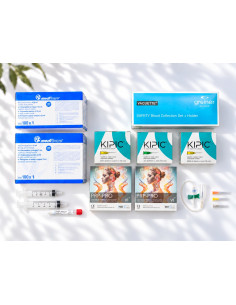
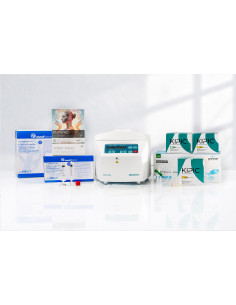
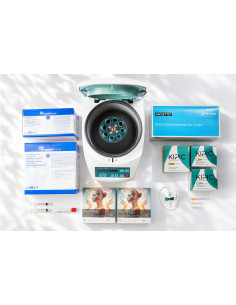
Once the workflow is defined, centrifuge and consumables can be compared against the intended process. The linked product pages provide technical details; the GOÄ guide explains German billing in more depth.
Frequently asked questions about PRP economics
How many PRP sessions are needed to break even?
Divide the investment by the positive contribution margin per completed session. Example: €2,500 investment and €125 contribution margin equals 20 sessions mathematically. Additional monthly fixed costs extend actual payback.
What is the “right” price for a PRP session?
There is no universal economically or medically correct fee. It depends on lawful billing, VAT status, time, materials, local market and service scope. Prices used in cost-effectiveness studies are not fee recommendations.
Can centrifugation be billed separately under the German GOÄ?
Not as a blanket rule. In the 2022 German Medical Association reference case, an additional analogue code solely for centrifugation was rejected.1 Billing must match the actual treatment case.
Can a PRP tube be charged as an expense under § 10 GOÄ?
Potentially, depending on the material and its specific use, but not automatically as a flat “kit” fee. Section 10 and its exclusions must be checked item by item; disposable syringes and needles, for example, cannot be billed separately.2
Are treatment packages automatically more profitable?
No. They may stabilize scheduling and utilization, but discounts reduce contribution margin. Clinical frequency must also never be chosen for commercial reasons.
Which PRP indication has the best ROI?
There is no defensible universal ranking. Evidence, treatment time, material need, billing, tax, demand and repeat rates differ by indication and practice.
Sources and further reading
Selected primary studies, systematic reviews and official German billing and tax sources. Last checked: 21 September 2026.
- Bundesärztekammer: Abrechnung von PRP in Kombination mit Hyaluronsäure, Deutsches Ärzteblatt, 22.08.2022
- Bundesärztekammer: § 10 GOÄ – Ersatz von Auslagen
- Bundesärztekammer: GOÄ-Novellierung – gemeinsamer Entwurf BÄK/PKV, Juli 2026
- Bundesministerium der Finanzen: Umsatzsteuerbefreiung für ästhetische Operationen und Behandlungen, 21.05.2026
- UStG § 4 Nr. 14 – Steuerbefreiung von Heilbehandlungen
- Riboh JC et al.: What Is the Appropriate Price for PRP Injections for Knee Osteoarthritis? A Cost-Effectiveness Analysis, 2020
- Auroux M et al.: Efficacy of intra-articular PRP compared with placebo in knee osteoarthritis – systematic review and meta-analysis, 2025
- Klifto CS et al.: PRP vs corticosteroid injections for recalcitrant lateral epicondylitis – cost-effectiveness Markov analysis, 2022
- Cost-Effectiveness Analysis for Treatment of Diabetic Foot Ulcer in France: PRP vs Standard of Care, 2022
- Cost-utility analysis of PRP for diabetic foot ulcers in Spain, 2020
- Platelet-Rich Plasma in the Management of Alopecia: Systematic Review and Meta-Analysis, 2025
- Platelet rich plasma for facial rejuvenation: an overview of systematic reviews, 2024
Professional information for medical users. This article does not replace individual medical indication, legal, tax or billing advice. Price and cost examples are provided only to illustrate the calculation method. Clinical decisions must not be derived from ROI targets.