
Shopping Cart
Professional article · Ocular surface · Updated July 2026
PRP eye drops in ophthalmology: What does the evidence show?
Blood-derived eye drops are mainly being studied for severe or persistent disorders of the ocular surface. This article reviews the evidence and explains why the tube, centrifuge and preparation process must be assessed as one connected system.
In brief
PRP eye drops are not a general procedure for treating “eye diseases”. They are mainly studied as a biological tear substitute for ocular-surface disorders, particularly dry eye and persistent corneal epithelial defects. Recent reviews suggest possible benefits for symptoms and ocular-surface staining. However, the studies differ considerably in preparation, concentration, administration and follow-up. Broad claims of healing or superiority are therefore not justified.1, 2, 3
What are PRP eye drops?
PRP stands for platelet-rich plasma. To prepare autologous PRP eye drops, blood from the individual concerned is medically processed. The aim is to obtain a plasma fraction with a higher platelet concentration than the starting blood. Following activation, platelets can release growth factors and other signalling proteins involved in repair and inflammatory processes at the ocular surface.
The term does not describe one standardised product. Depending on the method, platelet concentration, leukocyte content, activation, dilution, storage and dosage may differ. These variations make direct comparisons between clinical studies difficult.
Terminology matters: PRP eye drops, autologous serum eye drops, platelet lysate and “plasma rich in growth factors” are related but distinct blood-derived products. They should not be treated as equivalent. PRP is also not a stem-cell therapy.
Which conditions are being studied?
Dry eye disease
PRP eye drops are primarily studied in moderate to severe or treatment-resistant dry eye disease. A network meta-analysis of 16 randomised studies involving 898 participants found advantages over artificial tears for certain outcomes, including the Ocular Surface Disease Index and corneal fluorescein staining. The certainty of the findings remains limited because of methodological differences and risks of bias.2
Persistent corneal epithelial defects
PRP or PRGF eye drops have been used in case series and smaller comparative studies for defects that fail to heal despite standard care. Several publications report faster re-epithelialisation. However, the underlying causes varied, and large studies using consistent methods are lacking.4, 5
Neurotrophic keratopathy and complex ocular-surface disease
Blood-derived tear substitutes may have a role in specialist treatment plans for neurotrophic or otherwise severely damaged ocular surfaces. Treating the underlying cause and providing close ophthalmological follow-up remain essential.3, 6
Other eye diseases
The evidence reviewed here mainly concerns the ocular surface. It does not demonstrate efficacy for cataract, glaucoma, retinal disease or acute eye infections. PRP eye drops do not replace anti-infective, surgical or other cause-specific treatment.
What does the current evidence show?
The available data are encouraging overall, but inconsistent. A 2024 systematic review and meta-analysis assessed PRP for dry eye as potentially effective for subjective symptoms and objective signs.1 A further network meta-analysis compared several blood-derived products and found advantages for PRP eye drops over artificial tears for individual outcomes. In several direct comparisons, however, there were no statistically clear differences between the different blood-derived products.2
The current TFOS DEWS III report lists autologous serum and PRP as biological tear substitutes within a stepwise approach to dry-eye management. They should therefore be regarded as possible specialist options rather than universal first-line therapies.3
- Possible improvement in symptoms: Several studies reported lower symptom scores, measured for example with the OSDI.
- Possible improvement of the corneal surface: Fluorescein staining in particular showed positive signals in meta-analyses.
- Biological plausibility: Platelets release factors involved in epithelial migration, cell proliferation and tissue repair.
- No standardised preparation: The PRP preparations studied differ substantially in some cases.
- Limited comparability: Diagnoses, severity, concomitant treatment and outcome measures are not consistently standardised.
- Some studies are small: For many specific corneal conditions, only case series or small comparison groups are available.
- Limited long-term data: Evidence on durability, optimal treatment duration and rare risks remains limited.
PRP eye drops and autologous serum are not the same
| Feature | PRP eye drops | Autologous serum eye drops |
|---|---|---|
| Starting material | Plasma fraction with an enriched platelet component | Serum obtained after blood clotting |
| Platelets | Present and concentrated depending on the preparation method | Generally not present as a cellular fraction in the finished serum |
| Biological composition | Highly protocol-dependent; release of platelet-related factors is possible | Contains serum proteins and epitheliotrophic factors |
| Evidence | Growing but heterogeneous clinical evidence | Studied clinically for longer; preparation is likewise not fully standardised |
PRP tubes and centrifuges: relevant to the process, but not an ophthalmic clearance
The composition of a PRP fraction depends on more than the starting blood. Tube material, anticoagulant, separation gel, relative centrifugal force, run time, rotor, adapters and subsequent processing all affect the result. This is precisely why studies of PRP eye drops cannot simply be transferred to every commercially available PRP system.
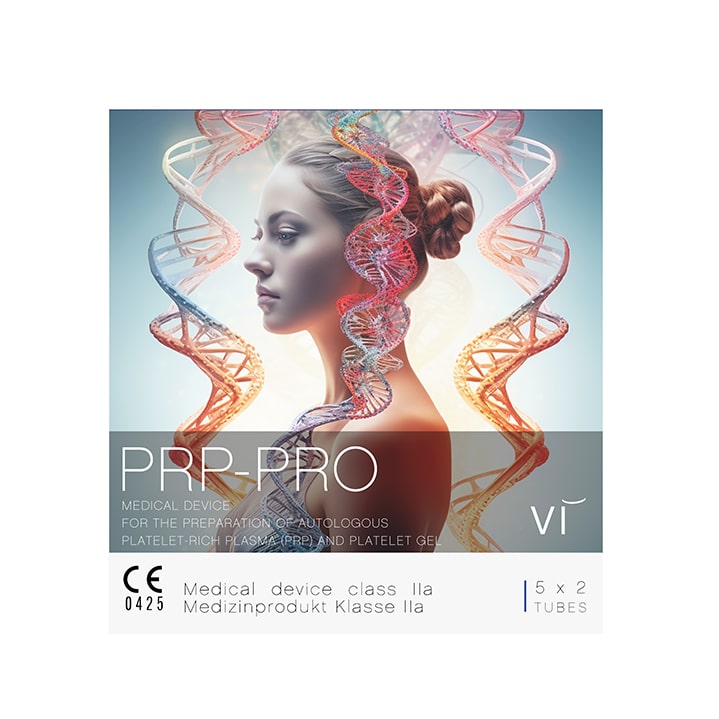
PRP tube
Vi PRP-PRO
Vi PRP-PRO is a sterile borosilicate-glass PRP tube for professional PRP preparation. It contains 0.8 ml sodium citrate and a thixotropic separation gel. The stated technical standard is 1,200 × g for 7 minutes.7
- Class IIa medical device
- CE 0425
- approximately 9 ml blood draw
- 10 sterile tubes per sales unit
Important distinction: These product data describe a professional PRP workflow. They do not demonstrate a specific intended purpose for producing eye drops and do not replace ophthalmic process validation.

Medical-device centrifuge
Hettich EBA 200 MD
The MD version of the EBA 200, order number 1810, is intended for separating whole blood or blood components of human origin. Its integrated eight-place fixed-angle rotor accommodates tubes up to 10 ml; the maximum values are 3,461 × g and 6,000 rpm.8
- Eight-place fixed-angle rotor
- up to 10 ml per tube
- maximum 3,461 × g
- maximum 6,000 rpm
For the Vi PRP-PRO standard, the product documentation gives approximately 3,500 rpm for the EBA 200 and EBA 200 MD as an indicative setting for 1,200 × g. The actual rotor radius, exact tube position and both instructions for use remain decisive.9
What must be assessed as a system before medical use
A technically compatible tube and a sufficiently powerful centrifuge are not enough on their own. The responsible facility must assess and document the complete process.
- Intended purpose: Review the product documentation, instructions for use and regulatory status of both components.
- Compatibility: Verify tube dimensions, rotor, adapters, loading, RCF and run time as one specific configuration.
- Further processing: Define sterile collection, filling, storage, shelf life and quality controls separately.
- Ophthalmic context: Assess suitability for an ophthalmic preparation independently from both a clinical and legal perspective; general PRP data alone are insufficient.
The key limitation: The technical specifications of Vi PRP-PRO and the Hettich EBA 200 MD do not automatically make them a validated system for PRP eye drops. They are presented here only as examples of components used in a professional, documentable PRP preparation workflow.
Safety, hygiene and professional responsibility
Autologous does not automatically mean risk-free. Blood collection, processing, filling, storage and administration must take place under appropriate hygienic and medical conditions. Ophthalmic preparations are particularly sensitive to microbial contamination. Individual factors also matter, including active infection, the cause of inflammation, coagulation disorders, systemic disease and concomitant medication.
The decision to use a blood-derived ophthalmic preparation therefore belongs in an ophthalmologically qualified setting. Preparation and quality assurance must comply with the applicable medical, medicinal-product, transfusion and hygiene requirements. Preparing or using such products independently is not acceptable.
Acute symptoms are not suitable for self-experimentation: Sudden deterioration of vision, severe pain, photophobia, injury, purulent discharge or suspected infection require prompt ophthalmological assessment.
What does this mean in clinical practice?
PRP eye drops are a specialist option for selected ocular-surface disorders. Dry eye and persistent corneal epithelial defects have been studied most extensively. The current evidence supports a cautiously positive assessment, but not claims that PRP is the “best”, “safest” or generally most effective treatment.
A sound treatment decision depends on diagnosis, cause, severity, previous treatment and the exact preparation protocol. A clear distinction between PRP, autologous serum and other blood components is equally important. Only then can study results be meaningfully applied to an individual clinical case.
For facilities that prepare PRP, the decisive factor is therefore not one product but the validated combination of tube, centrifuge, rotor, RCF, run time, hygiene and further processing. Documented compatibility for a general PRP workflow must not be equated with clearance for ophthalmic eye drops.
Frequently asked questions about PRP eye drops
Do PRP eye drops help every case of dry eye?
No. Dry eye is a heterogeneous disease with different causes. PRP eye drops are discussed mainly as a specialist option for severe, complex or insufficiently controlled cases. Selection depends on the diagnosis and clinical findings.
Are PRP eye drops the same as autologous serum?
No. Both are obtained from the patient's own blood, but they differ in preparation and composition. PRP contains an enriched platelet fraction; serum is produced after clotting and does not contain platelets as a cellular fraction.
Can PRP eye drops prevent or treat infections?
There is no basis for such a general claim. Infectious keratitis and other eye infections require targeted anti-infective treatment. PRP must not replace it.
Are PRP eye drops authorised and standardised?
The legal classification and the requirements for preparation and use depend on the country, care setting and exact procedure. A fully uniform international preparation protocol is still lacking. Clinics must review and document the requirements that apply to them.
Can PRP eye drops be made at home?
No. Preparation, sterile processing, storage and administration belong in a qualified medical setting. Improperly prepared products may damage the eye or be contaminated.
Can Vi PRP-PRO be used for PRP eye drops?
This cannot be concluded from the general product data. Vi PRP-PRO is described for professional PRP preparation, but that does not automatically establish an ophthalmic intended purpose. A facility would need to assess the suitability of the complete preparation process separately from clinical, hygiene and legal perspectives.
Are the Hettich EBA 200 MD and Vi PRP-PRO technically compatible?
The tube size and performance range are broadly compatible with the documented PRP protocol. Approximately 3,500 rpm is given as an indicative value for 1,200 × g. Nevertheless, rotor radius, adapters, tube position, balanced loading and the current instructions for use must be checked on site.
Scientific references and technical product information
- Akowuah PK et al. Platelet-rich plasma for treating dry eye disease - A systematic review and meta-analysis. Contact Lens and Anterior Eye. 2024;47(1):102091. PubMed
- Zhang Y et al. Blood component therapy for dry eye disease: a systematic review and network meta-analysis. Frontiers in Medicine. 2024;11:1500160. Full text
- Jones L et al. TFOS DEWS III: Management and Therapy. American Journal of Ophthalmology. 2025;279:289-386. PubMed
- Alizadeh S et al. Autologous Platelet-rich Plasma Eye Drops Accelerate Re-epithelialization of Post-keratoplasty Persistent Corneal Epithelial Defects. Journal of Ophthalmic & Vision Research. 2019;14(2):131-135. Full text
- Kim KM et al. Effect of autologous platelet-rich plasma on persistent corneal epithelial defect after infectious keratitis. Japanese Journal of Ophthalmology. 2012;56(6):544-550. PubMed
- Vaidyanathan U et al. Persistent Corneal Epithelial Defects: A Review Article. Medical Hypothesis, Discovery & Innovation in Ophthalmology. 2019;8(3):163-176. Full text
Technical product and manufacturer information
- prpmed.de. Vi PRP-PRO PRP tubes: technical product data, CE 0425, class IIa and standard setting of 1,200 × g for 7 minutes. Product page
- Andreas Hettich GmbH. EBA 200 MD, order number 1810: medical-device version, eight-place fixed-angle rotor, maximum RCF and speed. Manufacturer information
- prpmed.de. Hettich EBA 200 MD and device-specific technical guidance for Vi PRP-PRO; rotor radius and the instructions for use remain decisive. Product page