
Shopping Cart

Photoactivated PRP (PAPRP): Biological Background, Evidence Base and Practical Considerations
Professional article for physicians and medical professionals on photoactivated PRP: biological background, current evidence and practical considerations.
Read more
PRP in Psychiatry: Research on Depression and Anxiety Disorders
What role could platelets, BDNF and inflammatory processes play in depression and anxiety disorders? This article reviews the evidence and explains why PRP is not an established psychiatric treatment.
Read more
PRP Therapy in Animals: Applications and Evidence in Horses, Dogs and Cats
PRP is studied in veterinary medicine mainly for selected orthopaedic conditions and injuries. This article reviews possible applications in horses, dogs and cats and explains the current evidence, potential risks and important limitations.
Read more
PRP in Alzheimer’s, Parkinson’s and ALS: What the Research Really Shows in 2026
Platelet-based preparations are being investigated in cellular and animal models of neurodegenerative diseases. However, PRP, PRGF, platelet lysate, secretome and extracellular vesicles are not the same. This evidence review separates preclinical findings from human data and examines what can actually be concluded for Alzheimer’s, Parkinson’s and ALS as of September 1, 2026.
Read more
PRP Exosomes and Extracellular Vesicles: What the Research Shows
What does science actually tell us about so-called PRP exosomes? This professional article examines platelet-derived extracellular vesicles (EVs), current MISEV2023 terminology, separation and characterization, the available evidence, safety considerations and the regulatory framework. Preclinical findings are clearly distinguished from clinically established applications.
Read more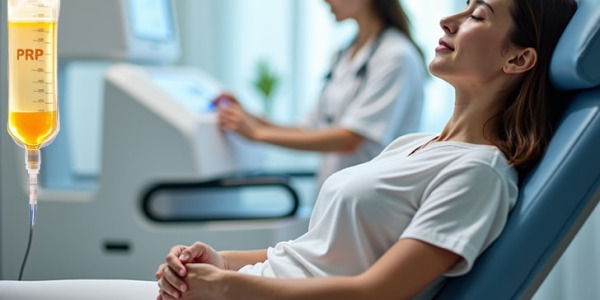
Intravenous PRP: What Research on IV-PRP Really Shows So Far
What do we actually know about intravenous PRP? This article examines human studies, safety data and case reports on IV-PRP and activated PRP preparations. It explains why conventional platelet-rich plasma should not be equated with the PRP-derived products investigated intravenously and where the evidence currently stands.
Read more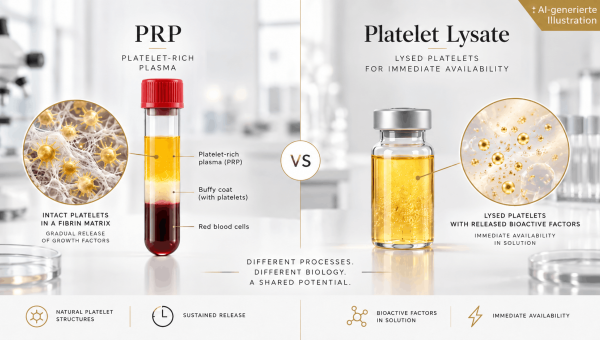
PRP and Platelet Lysate: What's the Difference?
PRP or Platelet Lysate – which procedure is right for you? This article highlights the differences between Platelet-Rich Plasma (PRP) and Platelet Lysate (PL) and shows when to use each procedure. Learn how both technologies are creating new possibilities in regenerative medicine.
Read more
Patient communication for PRP treatments: education and expectation management
Find out how to build trust, set realistic expectations and create long-term patient loyalty through effective patient communication for PRP treatments.
Read more
Long-term storage of PRP: progress, stability and the future of regenerative medicine
How stable is PRP at room temperature, under refrigeration or after freezing? This evidence-based overview examines platelet function, growth factors, sterility, freeze–thaw effects and lyophilisation—and explains why studies do not establish a universal shelf life.
Read more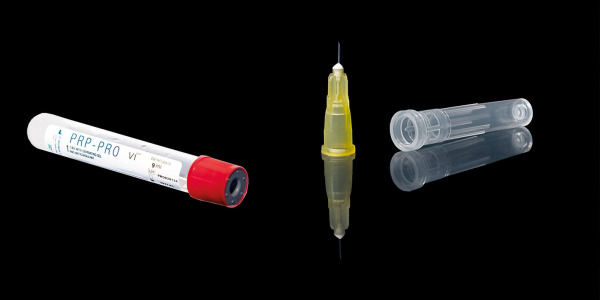
KIPIC Needles for PRP: Sizes, Selection Criteria and 34G × 8 mm Compared
Which KIPIC needle is suitable for a specific PRP protocol? This guide explains the differences between 25G and 34G needles, compares lengths from 4 to 42 mm and shows why the finest needle is not automatically the best choice. It includes a technical size comparison, information on flow resistance and viscosity, and a dedicated section on the new KIPIC 34G × 8 mm for suitable microinjection techniques.
Read more