Regenerative Medicine, PRP side effects, Patient education, Off-label therapy
Professional information · PRP · adverse events · updated September 2026
PRP side effects: what is expected and what is a warning sign?
PRP is prepared from autologous blood. This reduces some immunological concerns, but blood collection, processing and injection are not risk-free. The key question is whether a reaction arises from tissue response, the procedure, co-administered substances or patient-related factors.
In brief: The literature mainly reports mild, transient local reactions. Rare serious complications can occur. There is no scientifically valid single percentage for “the PRP risk” because preparations, indications, injection sites and study methods vary substantially.
Clinical orientation at a glance
The categories are intentionally qualitative. Frequencies cannot be reliably pooled across orthopaedics, trichology, aesthetics, urology and gynaecology.
Usually self-limitingPain, pressure, redness, swelling, warmth or bruising – depending on tissue, volume and technique.
Procedure-relatedDizziness, vasovagal reactions or syncope may be related to blood collection or injection.
Needs assessmentIncreasing pain, progressive redness or warmth, discharge, fever or loss of function.
Rare but relevantInfection, important vascular/nerve events and granulomatous reactions are rarely reported but may be serious.
Risk explorer: cause rather than a blanket frequency
Filter by the origin of the reaction. The cards do not represent an epidemiological frequency scale.
Local
Pain & pressure
Commonly related to needle trauma, tissue pressure or a local inflammatory response. Course and intensity matter more than presence alone.
Not automatically a warning sign.Local
Redness, swelling, bruising
Short-lived injection-site reactions are commonly described and vary by anatomical region.
Reassess if symptoms progress instead of improving.Local
Temporary symptom flare
Musculoskeletal studies often report short-term pain or swelling. LR-PRP may be more reactogenic than LP-PRP in some settings.
Indication- and preparation-specific.Procedure
Vasovagal reaction
Dizziness, nausea, pallor, cold sweat or syncope can be triggered by blood draw, pain, anxiety or injection.
Procedure-related, not PRP-specific.Procedure
Blood-draw reactions
Bruising at the puncture site or circulatory reactions belong to the blood collection process.
Document the likely cause separately.Additives
Reaction to co-administered substances
Activators, local anaesthetics, anticoagulants or other substances may have their own irritant or allergic reactions.
Record concomitant substances in history and documentation.High-stakes
Infection
Rarely reported, but clinically relevant because of potential consequences. Suspected infection after intra-articular injection requires prompt assessment.
Low observed frequency does not mean zero risk.High-stakes
Vascular, nerve and ocular risks
Misplacement and vascular or nerve injury are risks of invasive injection. A 2026 review collected 10 published cases of unilateral visual impairment after PRP, mostly after facial treatment.
Case reports cannot provide an incidence estimate.Case reports
Granulomatous / sarcoidal reactions
Sarcoidal lesions at previous PRP injection sites have been described in individual case reports. Causality and predisposition remain uncertain.
A case report is not a typical adverse event.
These categories describe origin and clinical importance, not a cross-indication frequency.
Where can risk arise? The PRP process chain
Safety starts before blood collection and continues through aftercare and documentation.
1Patient
History, indication, medication, infection status, coagulation and individual risk factors.
Possible risks
missed contraindications
relevant concomitant medication
infection or coagulation risk
Control points
document indication and history
review medication and infection status
clarify bleeding/coagulation risks
2Collection
Hygiene, correct tube filling and safe blood draw.
Possible risks
haematoma
vasovagal reaction
contamination during handling
Control points
follow hygiene standard
fill tubes correctly
use single-use materials
3Processing
System consistency, centrifugation parameters, handling and timing.
Possible risks
process variability
incorrect transfer of RPM values
contamination during open handling
Control points
document RCF, radius and run time
match tube/rotor/adapter
follow system-specific IFU
4Application
Anatomy, technique, target region, needle/cannula, volume and co-administered substances.
Possible risks
misplacement
vascular or nerve injury
infection or additive reaction
Control points
consider regional anatomy
define technique and material
document co-administered substances
5Aftercare
Explain expected reactions, define warning signs and document events.
Safety reporting is incomplete. In 2024 only 2 of 13 reviews had adverse events as a predefined outcome; a 2026 review collected 10 published cases of unilateral visual impairment, 9 after facial PRP.
Scalp / trichology
Typical short-term reactions
Injection pain, pinpoint bleeding/bruising, pressure and local irritation.
Important warning signs
Persistent inflammation, marked flare of a dermatosis, visual or neurological symptoms require assessment.
Safety evidence
Meta-analyses mainly report mild reactions. One of the 10 ocular cases in the 2026 review followed scalp PRP.
Orthopaedics
Typical short-term reactions
Short-term joint pain, swelling or stiffness.
Important warning signs
Severe or increasing pain, effusion, fever, warmth or loss of function.
Safety evidence
Best quantified field, but rates only apply to the investigated joint indications and protocols.
Urology / intimate medicine
Typical short-term reactions
Local pain, burning, small bruises or pressure.
Important warning signs
Bleeding, infection signs, marked swelling or persistent symptoms.
Safety evidence
Evidence remains heterogeneous in 2026, with many small or uncontrolled studies.
Gynaecology
Typical short-term reactions
Local pain, pressure, light bleeding/spotting or swelling.
Important warning signs
Infection signs, heavier bleeding or progressive symptoms.
Safety evidence
A 2026 review reported mainly few and mild AEs, but samples were small and protocols varied.
Show all specialties as a table
Area
Typical short-term reactions
Important warning signs
Safety evidence
Face / aesthetics
Erythema, oedema, bruising, pressure; sometimes papules or temporary dryness.
Safety reporting is incomplete. In 2024 only 2 of 13 reviews had adverse events as a predefined outcome; a 2026 review collected 10 published cases of unilateral visual impairment, 9 after facial PRP.
Scalp / trichology
Injection pain, pinpoint bleeding/bruising, pressure and local irritation.
Persistent inflammation, marked flare of a dermatosis, visual or neurological symptoms require assessment.
Meta-analyses mainly report mild reactions. One of the 10 ocular cases in the 2026 review followed scalp PRP.
Orthopaedics
Short-term joint pain, swelling or stiffness.
Severe or increasing pain, effusion, fever, warmth or loss of function.
Best quantified field, but rates only apply to the investigated joint indications and protocols.
Urology / intimate medicine
Local pain, burning, small bruises or pressure.
Bleeding, infection signs, marked swelling or persistent symptoms.
Evidence remains heterogeneous in 2026, with many small or uncontrolled studies.
Gynaecology
Local pain, pressure, light bleeding/spotting or swelling.
Infection signs, heavier bleeding or progressive symptoms.
A 2026 review reported mainly few and mild AEs, but samples were small and protocols varied.
What the current safety literature actually supports
More robust numbers come mainly from clearly defined indications and must not be transferred to all PRP applications.
Knee osteoarthritis · 2026 meta-analysis
32 RCTs · 1,268 PRP-treated knees
Adverse events were reported in 18.7% of PRP cases; mild knee pain and swelling in 10.6%. No severe adverse events were reported in the included groups.
These figures apply to intra-articular PRP for knee osteoarthritis, not facial, scalp or other indications.
All reported AEs
18.7%
Pain/swelling
10.6%
Severe AEs
0%
Orthopaedics · infection · 2024
91 RCTs · 5,914 knee injections
No joint infection was documented in studies with relevant reporting; preparation-environment reporting was incomplete in some trials.
Low observed event counts do not replace hygiene and process standards.
Facial aesthetics · 2024
2 of 13 reviews had an AE endpoint
Adverse events were rarely predefined outcomes in the umbrella review.
“Rarely reported” is not the same as “rarely present”.
Ocular vascular complications · 2026
7 publications · 10 cases
Nine cases followed facial and one scalp PRP; visual loss was immediate and painful in nine cases.
This is not incidence data, but it is an important high-stakes signal.
Vulvovaginal applications · 2026
18 studies · 401 PRP-treated women
Mostly few and mild AEs, but protocols were heterogeneous, samples small and methods limited.
The evidence does not support blanket safety claims.
Safety conclusions must remain preparation- and indication-specific.
≈ 1 : 2,000
Why “zero observed” does not mean “zero risk”. With 0 events among 5,914 observations, the approximate upper 95% boundary by the Rule of Three is about 0.05%, roughly 1 in 2,000. This is a statistical illustration, not an estimated PRP infection rate.
Evidence limit: Adverse events are not captured consistently. Preparations, leukocyte content, activation, anatomy, injection technique and follow-up vary. Missing reporting is not evidence of absent risk.
Red flags: the course matters more than one isolated symptom
This framework supports counselling and aftercare and does not replace an examination.
Typical course
Assess promptly
Urgent assessment
Nothing selected yet.
Orientation for professional users. With severe or rapidly progressive symptoms, clinical urgency is decisive. No input is stored.
Risk management in practice: four robust building blocks
Checklist for reproducible workflows and traceable documentation – not a treatment protocol.
0 / 16
1 · Before
2 · Processing
3 · Procedure
4 · After
Internal AE tracking template
Consistent data capture makes recurring patterns in your own workflow visible.
Event
Onset / duration
Severity
Region / side
PRP system
Tube
Batch / LOT
Additives
RCF / time
Preparation → application time
Application technique
Concomitant medication
Outcome
Further reading on prpmed.de
Patient selection, processing and materials – kept separate from the clinical indication decision.
Is PRP automatically safe because it is autologous?
No. Autologous origin reduces some immunological concerns but does not remove risks from blood collection, injection, hygiene, processing, anatomy or co-administered substances.
Is LR-PRP generally riskier than LP-PRP?
Not as a blanket statement. In the 2026 knee meta-analysis, mild pain/swelling versus hyaluronic acid was higher mainly in the LR-PRP subgroup; this should not be transferred to other indications.
How common are infections after PRP?
A general rate cannot be derived reliably. A 2024 knee review found no joint infection among 5,914 PRP injections in studies with relevant reporting; this is not a guarantee of zero risk.
Can allergic reactions occur?
Autologous plasma itself is different from a classic allergy to a foreign substance. Activators, local anaesthetics, anticoagulants or other co-administered substances must be assessed separately.
Have visual complications after PRP been described?
Yes, rarely in case reports. A 2026 review identified 10 cases of unilateral visual impairment, mostly after facial treatment. This does not allow an incidence estimate.
Which warning signs should not be dismissed?
Progressive pain, increasing redness/warmth, fever, discharge, marked systemic illness, relevant loss of function, and sudden visual or neurological symptoms.
Selected sources
Focus on safety data, reporting quality and indication-specific interpretation.
Nakagawa HF et al. Assessment of adverse events and safety associated with intra-articular platelet-rich plasma injections compared to other injectates for knee osteoarthritis: a systematic review and meta-analysis. PM&R. 2026. PubMed
Alazzeh MS et al. Platelet-rich plasma intra-articular knee injections from open preparation techniques do not pose a higher risk of joint infection: a systematic review of 91 randomized controlled trials and 5914 injections. J Exp Orthop. 2024. PubMed
Cruciani M et al. Platelet rich plasma for facial rejuvenation: an overview of systematic reviews. Blood Transfus. 2024. PubMed
Ebrahimzade M et al. Ophthalmic Vascular Occlusion and Blindness After Platelet-Rich Plasma Injections: A Systematic Review. J Cosmet Dermatol. 2026. Wiley
De Ponte A et al. Platelet-rich plasma in the management of vulvovaginal disorders: a systematic review. J Sex Med. 2026. PubMed
Systematic review/meta-analysis Platelet-Rich Plasma in the Management of Alopecia: clinical evidence. 2025. PubMed
Serizawa N et al. Platelet-Rich Plasma Injection and Cutaneous Sarcoidal Granulomas. Ann Dermatol. 2017. PMC
Izhakoff J et al. Platelet-rich plasma injections and the development of cutaneous sarcoid lesions: a case report. JAAD Case Rep. 2020. PMC
Rossi LA et al. Classification systems for platelet-rich plasma. Bone Joint J. 2019. PubMed
Hanley JA, Lippman-Hand A. If nothing goes wrong, is everything all right? Interpreting zero numerators. JAMA. 1983.
Professional notice: This article is for professional information. It does not replace individual indication, patient counselling, diagnosis, treatment decisions or a medical device IFU. Patient factors, professional medical assessment, manufacturer information, SOPs, hygiene requirements and applicable law remain decisive.
Certified Class IIa medical device – specifically designed for PRF and PRP therapies.
Maximum speed of 4500 RPM and RCF up to 2490 x g for precise and safe blood preparation.
Quiet operation at only 56 dB – ideal for use in quiet clinic or practice environments.
User-friendly controls with pre-set programs and easy parameter adjustments.
Highest...
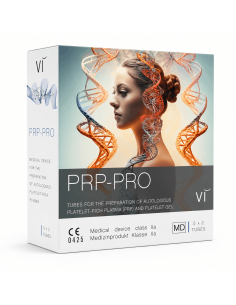
The VI PRP-PRO glass tube offers a modern solution for producing platelet-rich plasma (PRP) and ensures additional stability and reliability in treatments with a wall thickness of 2.4 mm. Developed with innovative technology and EC-certified (0425-MED-004180-00), it guarantees the highest level of safety and efficiency.
Key Features:
Certified...
You need to login or create account
Save products on your wishlist to buy them later or share with your friends.