
Shopping Cart
Evidence check · Aesthetic medicine
PRP injections for the lips: effects, limits and current evidence
PRP is not used in the lips like a conventional filler. The main discussion concerns possible, usually subtle changes in surface quality, colour and fine lines. Whether these effects occur reliably remains insufficiently studied.
Not a conventional fillerLimited evidenceMedical use only
The key assessment
PRP may influence lip quality, but predictable volume enhancement has not been demonstrated.
Direct research on PRP injections into the lips is largely limited to small, uncontrolled studies. They provide preliminary signals, not robust proof of efficacy and not a generally accepted treatment protocol.
What changes in the lips?
With age, lip contour, surface texture and colour may become less pronounced, while tissue volume can also decrease. These are separate issues: a smoother-looking surface is not the same as increased volume.
01
Surface
Fine lines, roughness and visible dryness affect appearance. Possible changes in this area are among the effects discussed for PRP.
02
Colour and contour
Small studies mainly report a more vivid colour. Reliable contour changes have not been established.
03
Volume
Targeted, reproducible lip enlargement has not been demonstrated with PRP. Conventional fillers are designed differently for this purpose.
What is PRP, and what is it intended to do in the lips?
Platelet-rich plasma is prepared from the patient’s own blood. Centrifugation separates blood components and produces a platelet-containing plasma fraction. Its exact composition depends on the system, centrifugation parameters and additional processing steps.
Platelets release several signalling molecules. This is the biological basis for studying PRP in relation to tissue response and skin quality. It does not automatically mean that visible collagen formation or a defined aesthetic result will occur in every person.
Important: PRP, PRF and heat-processed plasma gel are not the same. Results from one preparation must not be transferred to another without verification.
PRP or hyaluronic acid? Different objectives
PRP should therefore not be described as an equivalent “natural” lip filler. The approaches differ in purpose, material behaviour and predictability.
PRP
Usually discussed in connection with possible biostimulation, skin texture and subtle changes. The result cannot be shaped precisely, and lip-specific evidence is sparse.
Hyaluronic acid filler
Used to modify volume, contour or proportions in a targeted way. Its material properties and injection techniques are designed to create shape.
PRP should therefore not be described as an equivalent “natural” lip filler. The approaches differ in purpose, material behaviour and predictability.
What does the main lip study show?
A case series published in 2023 included 15 people with signs of lip ageing. Participants received three to six PRP sessions and were followed for three to 24 months.
15participants
3–6sessions
3–24months follow-up
Preliminary observations
Participants and physicians mainly reported changes in lip colour, skin texture and fine lines. Three participants experienced mild pain or discomfort during injection.
Major limitations
No control group, a small sample, different follow-up periods and mainly photographic or subjective assessment. Only one person underwent additional objective skin analysis.
No convincing change
Lip thickness and drooping mouth corners did not improve clearly in the study, which argues against presenting PRP as a reliable volumising treatment.
The authors themselves call for larger, controlled and long-term studies. The findings are preliminary signals, not proof.
What does the general process involve?
The workflow depends on the medical device, preparation system and physician’s protocol. There is no universally validated standard technique specifically for the lips.
Medical assessment
History, examination, realistic goal setting and discussion of alternatives and risks.
Blood collection
Collection under suitable hygienic conditions with accessories compatible with the system.
Preparation
Separation according to the instructions for use, rotor, radius, RCF and runtime.
Application and review
Injection by qualified medical professionals and follow-up according to the individual protocol.
Side effects remain possible, even with autologous blood
Autologous starting material reduces certain immunological risks but does not make an injection free of adverse effects. Pain, tenderness, redness, swelling, bruising, infection or an uneven result may occur. Additional substances such as local anaesthetics or activators have their own risk profiles.
Active inflammation or infection, bleeding disorders, anticoagulant medication and other medical conditions may rule out treatment or require specific assessment. The decision must be individual and medical.
Dry or cracked lips are not automatically an indication for PRP
Persistent dryness, inflammation or fissures may result from skin disease, medication, contact reactions or other causes. The current lip study does not provide robust evidence for treating these conditions with PRP. The cause should be medically assessed first.
Technical context for professionals
Preparation is a system process, not a single-product promise
Tubes and centrifuges must match the intended workflow technically and regulatorily. The links below describe professional preparation components and do not recommend a specific lip treatment.
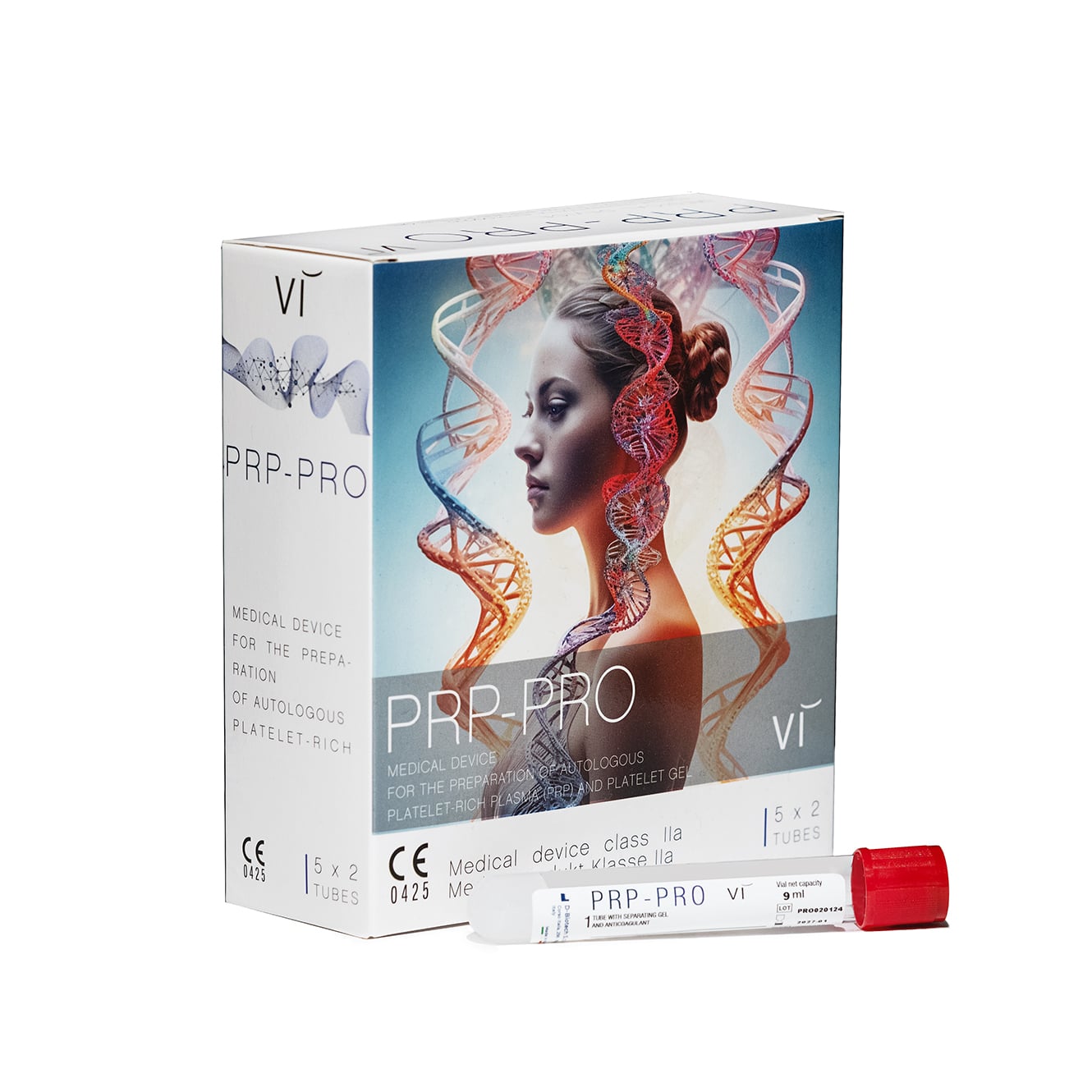
Vi PRP-PRO PRP tubes
Sterile borosilicate-glass tubes containing 0.8 ml sodium citrate and a thixotropic separation gel. The product-specific standard is 1200 × g for 7 minutes. The instructions for use, intended purpose and system compatibility remain decisive.
View PRP tubes
Hettich EBA 200 MD
Compact class IIa medical-device centrifuge with an eight-place fixed-angle rotor for tubes up to 15 ml. Time, speed and RCF can be set on the device. Rotor, radius and balanced loading must be verified.
View centrifugeThe value 1200 × g / 7 minutes belongs to the Vi PRP-PRO tube system and is not a universal PRP or lip protocol. RPM values must not be transferred unchecked because rotor radii differ.
Frequently asked questions
Direct research on PRP injections into the lips is largely limited to small, uncontrolled studies. They provide preliminary signals, not robust proof of efficacy and not a generally accepted treatment protocol.
Does PRP enlarge the lips?
A targeted and reliably reproducible increase in volume has not been demonstrated. In the small lip study, lip thickness did not change clearly.
Is PRP an alternative to hyaluronic acid?
Not as an equivalent filler. PRP is discussed in relation to tissue and skin quality, while hyaluronic acid is used for targeted contour and volume changes.
How many sessions are needed?
There is no generally validated schedule. The published case series used three to six sessions, but this does not prove that the schedule is optimal or transferable.
How long could an effect last?
This cannot currently be stated reliably. Studies are small, protocols differ and outcomes are not measured consistently.
Is PRP allergy-free because it comes from the patient?
Reactions to the patient’s own plasma are unlikely, but injection, hygiene and additive-related risks remain. A blanket guarantee would be inaccurate.
Are PRP, PRF and plasma gel interchangeable?
No. Preparation, cell content, fibrin structure and physical properties differ. Evidence must be assigned to the preparation that was actually studied.
Studies and further reading
Huang Y. et al. Application of platelet-rich plasma (PRP) in lips rejuvenation. Head & Face Medicine, 2023.Open source ↗
Hamid O. et al. Injectable platelet-rich fibrin for perioral rejuvenation as assessed by 3D lip volume imaging. Journal of Cosmetic Dermatology, 2021.Open source ↗
Alam M. et al. Effect of Platelet-Rich Plasma Injection for Rejuvenation of Photoaged Facial Skin: A Randomized Clinical Trial. JAMA Dermatology.Open source ↗
This article provides factual information for medical professionals and interested readers. It does not replace examination or advice and is not a recommendation for or against treatment. Medical devices must be selected, prepared and used according to their intended purpose, instructions for use and applicable law.
Medically reviewed: July 2026