
Shopping Cart
Technical setup for medical professionals
Equipment and consumables required for a PRP procedure
A PRP preparation workflow involves more than a tube and a centrifuge. Blood collection, centrifugation, plasma withdrawal, application, hygiene and documentation form one connected process. The key issue is therefore not the number of products, but their technical and regulatory compatibility.
This overview describes a practical basic setup using the Hettich EBA 200 MD and Vi PRP-PRO. It does not replace the instructions for use, an individual medical indication or the approved standard operating procedure of the responsible facility.
- Centrifuge
- PRP tube
- Safe blood collection
- Luer-Lock syringes
- Select needles for the procedure
- Hygiene
1200 × gVi PRP-PRO target
7 minStandard runtime
8Rotor positions
IIaMedical device
A PRP preparation workflow involves more than a tube and a centrifuge. Blood collection, centrifugation, plasma withdrawal, application, hygiene and documentation form one connected process. The key issue is therefore not the number of products, but their technical and regulatory compatibility.
This overview describes a practical basic setup using the Hettich EBA 200 MD and Vi PRP-PRO. It does not replace the instructions for use, an individual medical indication or the approved standard operating procedure of the responsible facility.
Three points define a controlled workflow
Four questions prevent most purchasing and transfer errors:
System coreTube, rotor, adapter, RCF, runtime and sterile accessories must be assessed as one process.
Tube, rotor, adapter, RCF, runtime and sterile accessories must be assessed as one process.
Speed cannot be transferred by itself. The actual centrifugal force also depends on rotor radius.
Loading, parameters, batch records, hygiene and disposal should be documented before routine use begins.
Equipment along the PRP workflow
Four questions prevent most purchasing and transfer errors:
Products in the workflowHettich EBA 200 MD · Vi PRP-PRO · RCF/RPM
Centrifuge: Hettich EBA 200 MD
This compact class IIa medical-device centrifuge has an integrated eight-place fixed-angle rotor. Time, speed and RCF can be set on the device. For Vi PRP-PRO, the technical standard is 1200 × g for seven minutes. This is not a universal protocol for other tubes. The rotor must be loaded symmetrically, with opposite positions filled as evenly as possible.

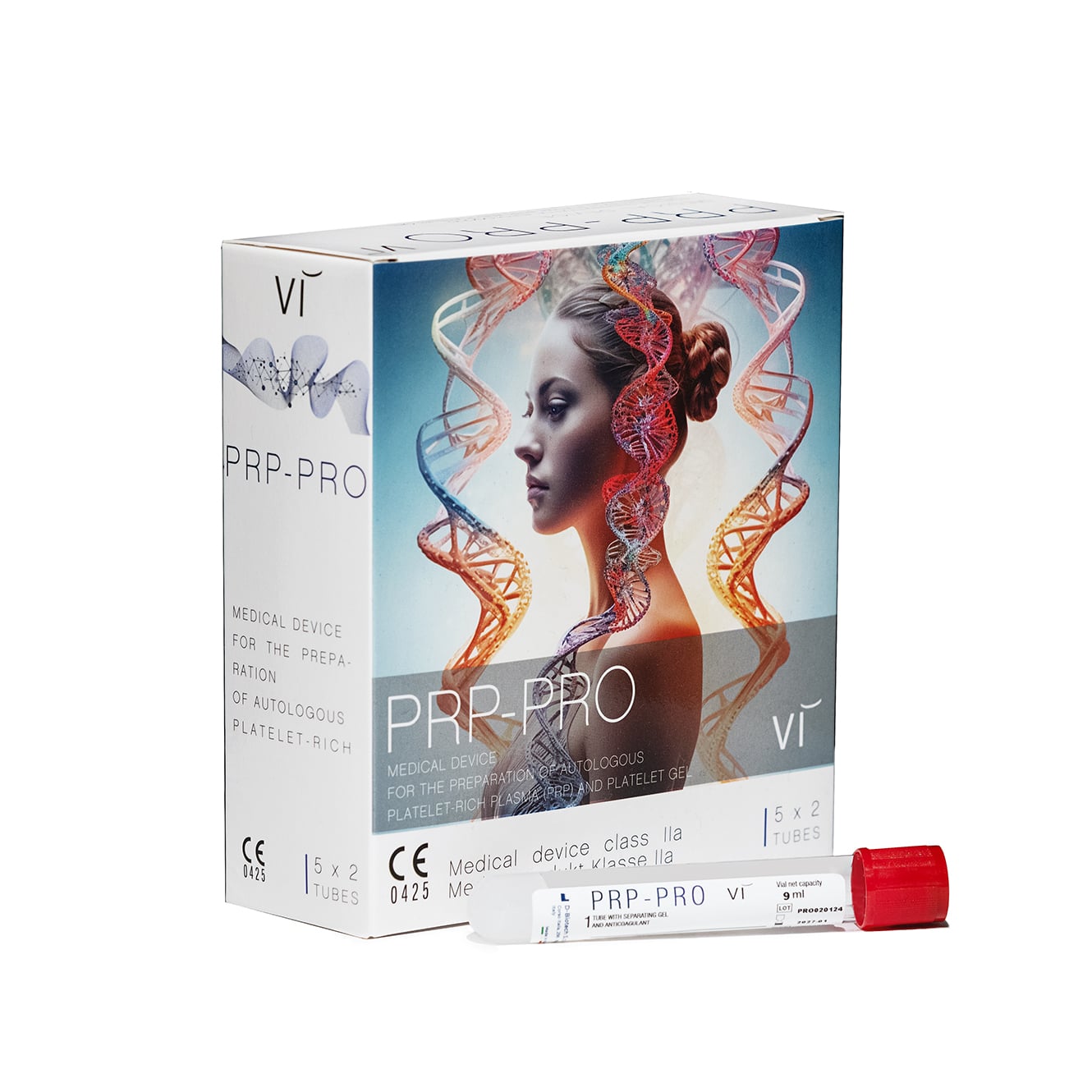
PRP tube: Vi PRP-PRO
Vi PRP-PRO is a sterile borosilicate-glass vacuum tube designed for approximately 9 ml of blood. It already contains 0.8 ml sodium citrate and a thixotropic separation gel. No separate anticoagulant or additional gel is required for this system. PRP, PRF and specialty tubes must not be interchanged merely because their dimensions appear similar.
Safe blood collection
Venous blood collection requires a compatible sterile safety set with holder. VACUETTE EVOPROTECT includes an integrated safety mechanism. The tube should be filled to the intended draw volume, as marked underfilling can change the blood-to-anticoagulant ratio.
Luer-Lock syringes
Sterile single-use syringes are used for withdrawing and dividing the prepared plasma. 2/3 ml and 5 ml Luer-Lock syringes cover different workflow steps. The threaded connection reduces the risk of unintended separation between syringe and needle. The approved protocol determines the required size.
Select needles for the procedure
One needle size does not suit every application. Length and gauge depend on the anatomical area, access route, injection depth and clinical technique. KIPIC 30G × 4 mm is one available option; selection remains a medical decision. Every needle is single use and must be discarded immediately in a sharps container.
Organisation and temporary storage
A tube rack is not required for centrifugation itself, but it supports orderly and stable placement before and after the run. The ten-place stainless-steel rack is intended for standard tubes up to approximately 1.5 cm in diameter. It does not replace a hygienic work surface.
Check compatibility before ordering
Four questions prevent most purchasing and transfer errors:
Check compatibility before ordering
Four checksFour checksTube ↔ rotor
Do diameter, length, adapter and operating position fit together?
Four checksProtocol ↔ device
Can the centrifuge deliver the required RCF and runtime using the actual rotor radius?
Four checksConnector ↔ accessory
Are the collection set, holder, Luer-Lock syringe and needle mechanically compatible?
Four checksIntended purpose ↔ use
Are all medical devices approved for the planned professional workflow?
What else must be available at the workstation
Hygiene
What else must be available at the workstation
Not every essential item is PRP-specific. Depending on the facility workflow, the setup also includes:
- Hand disinfectant and an appropriate skin antiseptic
- Single-use gloves and, where required, additional personal protective equipment
- Sterile swabs, gauze, dressings or plasters
- Surface disinfection and protective pads
- Puncture-resistant sharps container
- Waste container for contaminated disposables
- Batch and process documentation
- Current instructions for use and an approved SOP
Vi PRP-PRO
What Vi PRP-PRO does not automatically require
- separate sodium citrate
- additional separation gel
- PRF tubes as a supposedly equivalent substitute
- cell filters or adapters without a defined protocol
- a second centrifuge solely because a product uses a different name
Complete set or individual components?
A coordinated starter set reduces procurement work and combines the centrifuge, tubes, needles, syringes and blood collection materials. It does not remove the facility’s duty to verify intended purpose, instructions for use, rotor loading and internal process approval.
View PRP starter setChecklist before the first run
Check
Checklist before the first run
Items can be clicked directly. The status is only a browser-based working aid.
Frequently asked questions
Can any laboratory centrifuge be used with Vi PRP-PRO?
No. Tube holder, rotor, adapter, rotor radius, achievable RCF and the device’s intended purpose must match the process.
Why is RPM alone insufficient?
The same speed produces different centrifugal forces at different rotor radii. RCF is the more useful reference when transferring a protocol.
Is additional sodium citrate required?
Not with Vi PRP-PRO. The tube already contains 0.8 ml sodium citrate and a separation gel.
Which syringe size is correct?
That depends on the workflow step and the approved protocol. 2/3 ml and 5 ml cover different handling requirements.
Can a PRF tube be used as a substitute?
Not without verification. Tubes without anticoagulant follow a different process and are not automatically interchangeable.
Is the starter set sufficient for clinical operation?
It covers much of the product-specific equipment. Hygiene, disposal, training, medical records and an internal SOP are still required.
Professional and legal notice
Professional and legal notice: The information describes technical product characteristics and one possible material workflow. It is not a treatment recommendation, a promise of outcome or an assessment of suitability for an individual patient. The current manufacturer documentation, intended purpose, applicable law and the responsibility of qualified medical professionals remain binding.