
Shopping Cart

Dermatology · pigment disorders · evidence assessment
PRP and melasma
Melasma is a chronic pigment disorder with a marked tendency to recur. This article provides a factual overview of causes, diagnosis, photoprotection, established treatment approaches and clinical research on PRP.
- Diagnostics
- Photoprotection
- PRP studies
- Safety data
- Technical preparation
Multifactorial condition
Light, hormones, genetics, inflammatory processes and skin structure may interact.
Inconsistent studies
PRP protocols, accompanying treatments and measurement methods differ considerably.
Neutral assessment
The article describes study data and consensus positions without recommending for or against a treatment.
Melasma usually appears as symmetrical brown to grey-brown patches on the face. The condition is generally medically benign, but its visibility can affect personal wellbeing and quality of life.
Alongside established dermatological treatment approaches, researchers are investigating what role platelet-rich plasma, or PRP, might have in melasma. Published studies partly report changes in pigmentation, but comparison is limited by differing protocols and accompanying treatments.
What is melasma?
Melasma most commonly affects the forehead, cheeks, nose, upper lip and chin. The patches are usually distributed on both sides and may appear light brown, dark brown or grey-brown depending on skin type and pigment depth.
The condition is often chronic and may become more pronounced again after visible lightening. This applies particularly after renewed light exposure, hormonal changes or other individual triggers.
Melasma often presents as irregularly distributed, symmetrical facial hyperpigmentation.
How does melasma develop?
Its development cannot be reduced to a single cause. Current research suggests that several processes interact.
Genetics and hormones
Familial predisposition, pregnancy and other hormonal influences are frequently described.
UV and visible light
Light exposure can influence pigment formation and the tendency to recur.
Skin barrier and inflammation
Inflammatory processes and changes in the skin barrier are also being investigated.
Blood vessels and tissue structure
In addition to melanocytes, keratinocytes, fibroblasts, blood vessels and the basement membrane may be involved.
How is melasma diagnosed?
Diagnosis is usually based on the appearance of the skin and the medical history. Factors considered include distribution, possible hormonal influences, medicines, light exposure and treatments already carried out.
Dermoscopy or a Wood’s lamp can provide additional information and help distinguish melasma from other pigment changes.
Consider differential diagnoses
Post-inflammatory hyperpigmentation, lentigines, certain naevi, medication-related pigmentation or exogenous ochronosis can have a similar appearance.
Which treatment approaches are described?
Dermatological treatment is generally adapted to skin type, severity, possible triggers, previous treatments and the risk of post-inflammatory hyperpigmentation.
Broad-spectrum photoprotection and, depending on the situation, additional protection against visible light.
Depending on the region and medical selection, options may include hydroquinone combinations, azelaic acid or kojic acid.
Described in the literature in different formulations and combinations.
Selection depends on skin type, clinical course, pigment depth and the individual risk profile.
What is the importance of photoprotection?
UV radiation is an important contributing factor in melasma. Visible light can additionally increase pigment formation, particularly in darker skin phototypes.
Photoprotection as a long-term component
Studies and consensus papers describe daily photoprotection as a fundamental part of long-term melasma management. Tinted sunscreens containing iron oxides are discussed in relation to visible light.
What is PRP?
PRP stands for platelet-rich plasma. It is obtained from the patient’s own blood. A defined centrifugation process separates the blood components and prepares a plasma fraction with an increased platelet concentration.
Platelets contain signalling proteins and growth factors. In melasma research, investigators are examining whether these components may influence inflammatory processes, vascular structures, melanogenesis and remodelling processes in the skin.
Separate the biological concept from clinical effects
Biological plausibility explains why PRP is being studied, but does not by itself demonstrate a clinical effect.
How has PRP been used in melasma?
Studies to date have used different procedures. These include intradermal injections, microneedling followed by PRP application, and combinations with tranexamic acid, hydroquinone or other topical agents.
Simplified procedure in PRP studies
The exact procedure was not uniform. The diagram shows only common basic elements.
Step 1
Blood collection
Autologous blood is collected in a tube intended for the respective system.
Step 2
Preparation
Centrifugation according to defined system- and product-specific parameters.
Step 3
Application in the study setting
Depending on the protocol, intradermally, after microneedling or in combination with other procedures.
What did the frequently cited pilot study show?
A randomised split-face pilot study examined ten women with bilateral mixed-type melasma. One side of the face received intradermal PRP injections, while the other received saline solution. Four sessions were carried out at two-week intervals.
Split-face pilot study
PRP versus saline solution in bilateral melasma
10
Female participants
4
Sessions
2
Weeks between sessions
6
Weeks to the main assessment
Some measurement methods showed greater changes on the PRP side. Other measurements found no significant difference. The recorded adverse effects were mild and temporary.
Important limitations
Small number of participants, exclusively female population and short follow-up. The results therefore cannot automatically be transferred to other patient groups or PRP protocols.
What do systematic reviews and comparative studies show?
Systematic reviews mainly report small studies with differing designs. Several publications describe lower MASI or mMASI scores or greater patient satisfaction. With combined treatments, however, the contribution of PRP itself often remains unclear.
More recent split-face comparisons examined, for example, microneedling with PRP on one side of the face and microneedling with tranexamic acid on the other. Individual measurements differed, whereas other clinical or subjective assessments were similar.
Assessment of the available data
Study size
Comparability of protocols
Short-term measurement data
Long-term data
How is PRP positioned in current consensus documents?
International consensus papers highlight photoprotection, hydroquinone-containing combinations under medical supervision, other topical agents, tranexamic acid and selected additional procedures as central components of melasma management.
At the same time, PRP is addressed in clinical studies and systematic reviews as an investigated or adjunctive procedure. This reflects the current position: a growing area of research without uniform standardisation.
Neutral retailer perspective
prpmed does not derive a recommendation for or against a specific treatment from study findings or consensus positions.
What adverse effects have been documented?
Small studies have mainly described mild and temporary local reactions. Depending on the form of application, pain, redness, swelling or small haematomas have been reported.
The groups studied to date are mostly small and follow-up periods are often short. Statements on long-term safety are therefore less robust than information on short-term local reactions.
Technical context of PRP preparation
The composition of the resulting PRP does not depend solely on the volume of blood collected. The tube system, anticoagulant, separation gel, rotor radius, relative centrifugal force and run time also influence the preparation process.
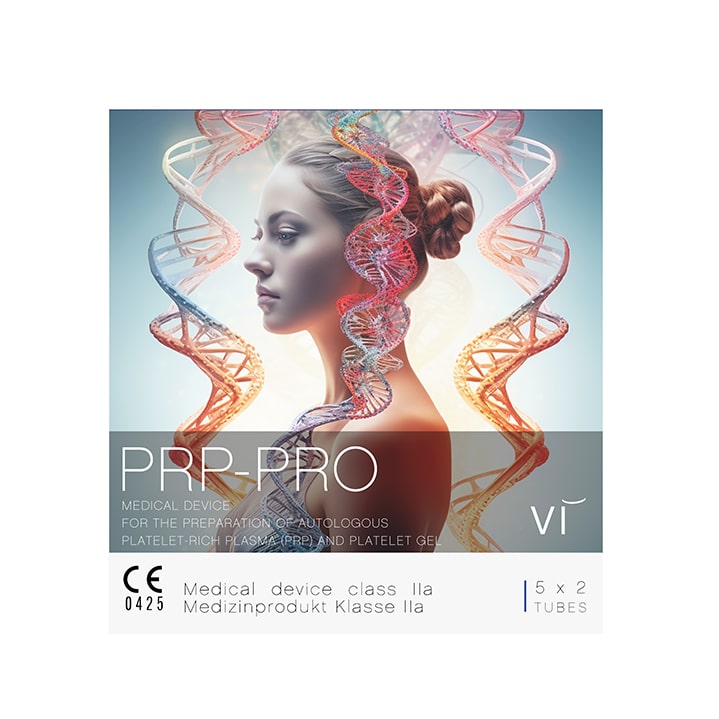
Technical example
Vi PRP-PRO PRP tubes
Borosilicate glass, 0.8 ml sodium citrate and a thixotropic separation gel. The product-specific standard protocol specifies 1,200 × g for seven minutes.
- Blood draw volume
- approximately 9 ml
- Anticoagulant
- 0.8 ml sodium citrate
- Protocol
- 1,200 × g for 7 minutes
- Context
- technical PRP preparation

Technical example
Hettich EBA 200 MD
Compact medical-device centrifuge with an integrated eight-place fixed-angle rotor. The manufacturer specifies a maximum of 8 × 10 ml, 6,000 rpm and 3,461 × g.
- Rotor
- 8-place, fixed angle 33°
- Capacity
- maximum 8 × 10 ml
- Max. RCF
- 3,461 × g
- Max. speed
- 6,000 rpm
Clearly separate technical information from the indication
The product data mentioned describe only technical components of PRP preparation. They do not support statements about suitability, efficacy or approval for a specific dermatological application.
Why can PRP studies be compared only to a limited extent?
Differences between the studies include:
- the initial blood volume,
- the type of PRP tubes and anticoagulant,
- single- or multi-stage centrifugation,
- the platelet and leukocyte concentration achieved,
- possible activation,
- the injection or microneedling technique,
- the number of sessions and the interval between them,
- concurrently used active ingredients.
A result from a specific study system therefore cannot be transferred without review to every other tube, centrifuge or treatment protocol.
Can melasma recur?
Melasma has a marked tendency to recur. Visible lightening does not necessarily mean that pigmentation has permanently disappeared. Light exposure, hormonal changes and other individual factors can influence the course.
In dermatological practice, a distinction is therefore often made between initial treatment and a longer-term maintenance strategy.
Frequently asked questions about PRP and melasma
Is PRP an established standard treatment for melasma?
PRP is being clinically studied both alone and in combination with other procedures. Current consensus summaries do not highlight it as a central standard component.
How many PRP sessions have been studied?
Protocols differ. In the frequently cited pilot study, four sessions were carried out at two-week intervals. Other studies used different intervals and numbers of treatments.
Has PRP been studied alone or in combination?
Both. Studies have examined intradermal PRP, combinations with microneedling and combinations with tranexamic acid or other active ingredients.
Can long-term effects be assessed?
Many studies have short follow-up periods. Larger studies with uniform protocols and longer observation are needed to assess long-term changes and recurrence rates more precisely.
Why are PRP tubes and the Hettich EBA 200 MD mentioned?
They are cited as examples of technical components used in a professional PRP preparation process. This does not imply any statement about a specific dermatological application.
Summary of the evidence
PRP in melasma is the subject of clinical research. Several small studies report changes in MASI or mMASI scores, instrumental pigment measurements or patient satisfaction. Other measurement methods sometimes show no clear differences.
Interpretation is complicated by small participant numbers, predominantly female study populations, different PRP systems, combined treatments and short follow-up periods. The current research therefore provides indications and open questions, but not a uniform picture for all patient groups or preparation methods.
Sources and further information
- International expert consensus: Global consensus on melasma management
- Pathogenesis: Current understanding of melasma pathophysiology
- Diagnostics: Diagnostic approaches in melasma
- Visible light and photoprotection: Visible light protection in melasma
- PRP pilot study: Split-face study of PRP in melasma
- Meta-analysis: PRP for melasma: systematic review and meta-analysis
- Systematic review: PRP in the treatment of melasma
- Recent comparative study: PRP versus tranexamic acid with microneedling
- Manufacturer information for the Hettich EBA 200
- Product information for Vi PRP-PRO
Medical notice: This article presents published study results, consensus positions and technical information for informational purposes. It contains no recommendation for or against a specific treatment and does not replace a dermatological examination, diagnosis or individual treatment decision. Product references relate exclusively to technical aspects of PRP preparation.