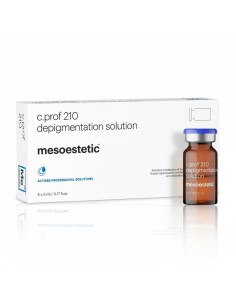
mesoestetic® Pre-Procedure Cleansing Solution 150ml
Preparatory cleansing solution for professional use
The mesoestetic® Pre-Procedure Cleansing Solution is a professional, degreasing and mildly keratolytic cleansing solution designed to prepare the skin prior to aesthetic treatments. It effectively removes excess sebum, make-up residues and dead skin cells from the stratum corneum.
Content: 150 ml (1 bottle)
mesoestetic® · Skin preparation
The solution that starts the procedure – not the one that performs it
Pre-Procedure Cleansing Solution is a degreasing cleansing solution for the step before the actual treatment. It removes sebum, make-up residue and loose flakes from the skin surface and leaves a clean, even surface for the subsequent protocol.
The formulation contains four acids – glycolic, lactic, salicylic and lactobionic acid – as well as a sugar-based surfactant and several solvents. Chamomile flower extract and bisabolol are additional ingredients in the formulation. 150 ml per bottle, intended for professional in-cabin use.
- Product type
- Cosmetic product (Regulation (EC) No 1223/2009)
- Use
- Cleansing and degreasing before cosmetic and aesthetic procedures
- Contents
- 1 bottle of 150 ml
- Acids in the INCI list
- Glycolic acid (AHA), lactic acid (AHA), salicylic acid (BHA), lactobionic acid (PHA)
- Skin area
- Face, according to the respective treatment protocol
- Supply
- For professional users only
Price per 100 ml–
What this step does
Four things that should happen before the treatment
This is a cleansing product. It does not replace a treatment and is not a peel – its purpose is limited to cleansing the skin surface.
01Degrease
Remove sebum film and make-up residue
Alcohol Denat., acetone and propylene glycol dissolve greasy residue; Decyl Glucoside helps bind it. Both are then removed from the skin with the compress.
INCI: Alcohol Denat. · Acetone · Propylene Glycol · Decyl Glucoside
02Smooth
Remove loose flakes
The formulation contains four acids. prpmed does not infer an independent peeling or keratolytic effect from this; this page describes only the cleansing step before treatment.
INCI: Glycolic Acid · Lactic Acid · Salicylic Acid · Lactobionic Acid
03Acids in the formulation
Four hydroxy acids are declared
Glycolic Acid, Lactic Acid, Salicylic Acid and Lactobionic Acid are listed in the INCI. Sodium Hydroxide is declared as a pH-regulating ingredient. prpmed does not state a specific pH value without manufacturer information.
INCI: Sodium Hydroxide as pH regulator
04Even surface
A defined starting point
On a degreased, evenly cleansed surface, the subsequent protocol can be carried out consistently – from product quantity to documentation.
INCI: Polyquaternium-10 as a film-forming ingredient for distribution
Chamomilla Recutita Flower Extract and Bisabolol are listed in the INCI for this formulation. prpmed does not make claims about a soothing effect on the skin.
Interactive · Skin surface
What the compress removes
Move the slider: the area on the left has already been cleansed, while residues are shown schematically on the right. The graphic shows only the surface of the stratum corneum and makes no statement about penetration of ingredients.
Sebum and make-up filmMake-up pigmentsloose flakesStratum corneum
Schematic illustration explaining the work step. It does not show a treatment course or an expected result.
Interactive · Acids in the formulation
Four acids, four molecular sizes
AHA and BHA refer to the position of a hydroxy group relative to the carboxyl group; PHA refers to polyhydroxy acids with several hydroxy groups. This classification alone says nothing about the strength or tolerability of a product. The axis shows the molar mass (logarithmic); the area of the dots is proportional to it. Tap a dot for details.
molar mass in g/mol
Select one of the four acids to see its structural formula, class and role in the formulation.
Glycolic acid
AHA · Alpha-hydroxy acid
- INCI
- Glycolic Acid
- Molecular formula
- C2H4O3
- Molar mass
- 76,05 g/mol
- Position in the INCI list
- No. 5 of 17
The smallest molecule of the four. Glycolic acid is readily soluble in water and is produced industrially from sugar cane or synthetically.
In this formulation it is fifth in the INCI list. Its exact concentration and the pH of the finished formulation cannot be derived from this position alone.
Lactic acid
AHA · Alpha-hydroxy acid
- INCI
- Lactic Acid
- Molecular formula
- C3H6O3
- Molar mass
- 90,08 g/mol
- Position in the INCI list
- No. 8 of 17
Lactic acid is produced during sugar fermentation. It is water-soluble and hygroscopic.
It is eighth in the INCI list. Its exact concentration in the finished formulation cannot be determined from this position alone.
Salicylic acid
BHA · Beta-hydroxy acid
- INCI
- Salicylic Acid
- Molecular formula
- C7H6O3
- Molar mass
- 138,12 g/mol
- Position in the INCI list
- No. 9 of 17
Compared with the other three acids listed here, salicylic acid is more lipophilic and can therefore distribute more readily in greasy residue.
Regulatory restrictions apply to the use of salicylic acid in cosmetic products. The current label and the manufacturer information for the supplied product are decisive.
Lactobionic acid
PHA · Polyhydroxy acid
- INCI
- Lactobionic Acid
- Molecular formula
- C12H22O12
- Molar mass
- 358,30 g/mol
- Position in the INCI list
- No. 10 of 17
At 358.30 g/mol, lactobionic acid has almost five times the molar mass of glycolic acid. It is formed by oxidation of lactose and consists of a galactose ring and an open gluconic-acid chain.
Its numerous hydroxy groups explain its high water solubility. In the INCI list it is the fourth of the acids shown here.
Molar masses calculated from the molecular formula. Molecular size alone says nothing about the tolerability of a product – concentration, pH and the formulation as a whole are what matter. The manufacturer does not state the concentrations in this formulation.
Interactive · Composition
INCI check: 17 ingredients, seven questions
Common practical questions checked directly against the declaration. Tap a question – the relevant ingredients are highlighted in the formula band and table.
Seven questions, seven answers directly from the INCI list. Tap a question.
Yes. Alcohol Denat. is second in the INCI list. It acts as a solvent and evaporates quickly. An exact concentration cannot be derived from its position in the INCI list.
Yes. Acetone is fourth in the list. Acetone is a solvent for greasy residue. Together with the alcohol present, the manufacturer labelling on flammability must be observed during use; the solution is flammable – keep away from ignition sources.
Yes, all three classes: glycolic and lactic acid as AHA, Salicylic acid as BHA, Lactobionic acid as PHA. They are part of the acidic formulation. The manufacturer does not state the concentrations.
Yes, one: Decyl Glucoside, a mild sugar-based surfactant. It helps bind sebum and dirt so both can be removed with the compress.
Yes, two: Chamomilla Recutita Flower Extract (chamomile flower extract) and Bisabolol, a constituent of chamomile oil. Both appear in the latter part of the INCI list. Below the 1% threshold, however, the order does not allow an exact concentration to be inferred.
Yes. The preservative system contains Phenoxyethanol and Ethylhexylglycerin; Parfum is the final entry. If there is a known fragrance intolerance, review the INCI list with the client beforehand.
The INCI list for this formulation contains no silicones (endings “-cone”, “-siloxane”) and no oils or butters. This is a statement about the composition of this product, not an assessment of other products.
The 17 fields follow the declared INCI order. Ingredients above 1% are generally listed in descending order; ingredients at or below 1% may then appear in any order. Tap a field or ingredient group.
Complete INCI list with function (17 ingredients)
| No. | INCI | Ingredient group | Function in this formulation |
|---|---|---|---|
| 1 | Aqua | Water | Water – base of the solution. |
| 2 | Alcohol Denat. | Solvents & humectants | Denatured alcohol. Dissolves greasy and make-up residue and then evaporates quickly. |
| 3 | Propanediol | Solvents & humectants | Solvent. Helps keep the formulation clear and evenly distributable. |
| 4 | Acetone | Solvents & humectants | Solvent. Takes up greasy residue. Long used in cosmetics, for example in nail products. |
| 5 | Glycolic Acid | Acids (AHA · BHA · PHA) | Glycolic acid – AHA, 76.05 g/mol. Smallest of the four acid molecules. |
| 6 | Decyl Glucoside | Surfactant | Mild sugar-based surfactant. Helps bind sebum and dirt so both can be removed with the compress. |
| 7 | Sodium Hydroxide | pH adjustment | Sodium hydroxide. Used to adjust the pH of the solution by neutralising part of the acids. |
| 8 | Lactic Acid | Acids (AHA · BHA · PHA) | Lactic acid – AHA, 90.08 g/mol. Water-soluble and hygroscopic. |
| 9 | Salicylic Acid | Acids (AHA · BHA · PHA) | Salicylic acid – BHA, 138.12 g/mol. Lipophilic and therefore more compatible with greasy residue. |
| 10 | Lactobionic Acid | Acids (AHA · BHA · PHA) | Lactobionic acid – PHA, 358.30 g/mol. Largest of the four molecules and strongly water-soluble. |
| 11 | Propylene Glycol | Solvents & humectants | Solvent and humectant. |
| 12 | Chamomilla Recutita Flower Extract | Plant-derived ingredients | Chamomile flower extract. |
| 13 | Bisabolol | Plant-derived ingredients | Constituent of chamomile oil, listed here as an individual formulation ingredient. |
| 14 | Polyquaternium-10 | Film former | Film former. Improves feel and even distribution on the skin. |
| 15 | Phenoxyethanol | Preservation | Preservative. |
| 16 | Ethylhexylglycerin | Preservation | Preservative component used together with phenoxyethanol. |
| 17 | Parfum | Fragrance | Fragrance. |
Declaration according to Art. 19 of Regulation (EC) No 1223/2009: ingredients are listed in descending order by weight; below 1% they may be listed in any order. The information on the packaging of the supplied product is always decisive.
Interactive · Calculation
Bottle yield and volume discounts
How long 150 ml lasts depends on how much solution you put on the compress per application. Set your value.
- Applications per bottle
- –
- Cost per application
- –
- Contents
- 150 ml
Calculated value assuming no residue remains in the bottle. The actual amount per application depends on the treated area and protocol.
Example: at 2 ml per application, 150 ml gives approximately 75 applications per bottle; at 3 ml, around 50.
- Price per bottle
- –
- Total
- –
- Saving versus single-unit price
- –
The volume discounts for this item are shown in the price box above. All prices include statutory VAT where applicable, plus shipping costs.
Application
Four steps as stated in the protocol
- Remove make-up and assess the skinRemove decorative cosmetics roughly and inspect the skin. Do not cleanse open lesions, recently treated areas or acutely irritated skin; postpone the step instead.
- Apply solution to the compressKeep the bottle closed and apply the solution to a gauze or cellulose compress – do not spray or pour directly onto the skin. Use the amount specified by the treatment protocol.
- Wipe the area to be treatedWork over the area with light pressure, avoiding eyelids, the red part of the lips and mucous membranes. Replace the compress when visibly soiled.
- Continue according to protocolAllow the skin to dry, then carry out the next step of the relevant treatment protocol. Do not return any remaining solution to the bottle.
The manufacturer instructs users to apply the product to the area to be treated and to use it according to the respective treatment protocol. For professional use only. The treating professional is responsible for indication, sequence and documentation.
Product data & safety
Key information at a glance
Product data
- Trade name
- mesoestetic® Pre-Procedure Cleansing Solution
- Item number
- 100369
- Contents
- 1 bottle of 150 ml
- Product type
- Cosmetic product under Regulation (EC) No 1223/2009
- Application area
- Face, external use
- Ingredients
- 17 according to INCI, including four acids
- Storage
- Keep cool and dry; keep bottle closed
- Manufacturer / GPSR
- MESOESTETIC E-COMMERCE, S.L., C/ de la Tecnologia 25, 08840 Viladecans (Barcelona), Spain
Read before use
- Flammable. The solution contains Alcohol Denat. and Acetone. Keep away from open flames, sparks and hot equipment; keep the bottle closed.
- For external use only. Do not inject or ingest. Avoid contact with eyes, eyelid margins, the red part of the lips and mucous membranes; in case of contact, rinse immediately with plenty of water.
- Do not use on damaged skin. Do not apply to open, irritated or recently treated skin, eczema or sunburn.
- Contains acids. Contains glycolic, lactic, salicylic and lactobionic acid. If there is a known intolerance to fruit acids, salicylates or fragrances, check the INCI list beforehand.
- For professional use only. Supplied exclusively to professional users and authorised purchasers. Keep out of reach of children.
- Regulatory framework. The requirements governing cosmetic products and their proper use must be followed. The label and accompanying information supplied with the product are decisive.
Questions from practice
Frequently asked questions
Is this solution a cosmetic product or a medical device?
It is a cosmetic product under Regulation (EC) No 1223/2009. It is intended for cleansing the skin, not for treating disease. It therefore has neither CE marking nor a medical intended purpose.
What is the difference between this solution and a peel?
Its purpose. A peel is the treatment itself; this solution is the cleansing step beforehand. The formulation contains several acids but is described here as a pre-treatment cleansing step. prpmed does not infer an independent peeling or keratolytic effect from it. The subsequent treatment is determined by the protocol.
The solution contains alcohol and acetone – what should I consider?
It is flammable: no open flames, sparks or hot equipment nearby, and keep the bottle closed. Both substances also evaporate quickly, so the compress should be used promptly and not left exposed. Avoid eyes and mucous membranes.
Which skin types is it suitable for?
The manufacturer states that it is suitable for all skin types. For sensitive skin, known intolerance to fruit acids, salicylates or fragrances, or concurrent use of acidic home-care products, the professional should assess suitability individually and test tolerability on a small area beforehand.
How many applications does one bottle provide?
That depends on the amount used per application. At 2 ml each, 150 ml gives around 75 applications; at 3 ml, around 50. The calculator above uses your value and the current price on this page.
How should the solution be stored?
Keep cool, dry and closed, protected from direct sunlight and heat sources. Do not return unused poured-out product to the bottle. Follow the packaging instructions for shelf life and period after opening.
Can the solution be combined with other mesoestetic products?
It is intended as a preparation step within mesoestetic protocols. The manufacturer’s relevant treatment protocol specifies which products follow and in what order; prpmed does not make its own combination recommendations.
Cosmetic product under Regulation (EC) No 1223/2009. Supplied exclusively to professional users and authorised purchasers; the rules governing cosmetic products and their proper use must be followed. The information on this page is for product information and does not replace individual professional assessment. The label, INCI list and manufacturer information supplied with the product are decisive.
GPSR – General Product Safety Regulation (Allgemeine Produktsicherheitsverordnung)
Verantwortlicher Wirtschaftsakteur gemäß GPSR:
MESOESTETIC E-COMMERCE, S.L.
- Address: C/ de la Tecnologia, 25, 08840, Viladecans (Barcelona)
- Email: [email protected]
- Phone: +34 93 325 20 30