PRP in Gynecology: The medical reality behind "vaginal rejuvenation"
01
What is actually meant by "vaginal rejuvenation"?
The term "vaginal rejuvenation" sells well, but medically it is vague. Under the same heading, studies cover completely different topics: genitourinary syndrome of menopause, vulvovaginal atrophy, dyspareunia, sexual dysfunction, vaginal laxity and, in some cases, even adjacent urogynecological complaints. If you do not separate these cleanly, you end up talking about everything and proving nothing.
PRP in gynecology is therefore not a single procedure for one clearly defined indication, but rather a broad field of different regenerative approaches. The clinical question is not whether PRP "rejuvenates", but whether it brings short-term or longer-term relevant improvements in clearly defined symptom patterns. This is exactly where the literature becomes thin, heterogeneous and, at times, unnecessarily loud.
One marketing term, several medical problems
In practice, "vaginal rejuvenation" usually means one of four things: less dryness and dyspareunia in postmenopausal atrophy, better sexual function, subjectively perceived tightening in vaginal laxity, or an improvement in local mucosal and tissue parameters. The problem is that these endpoints are neither biologically nor methodologically the same. If you throw dryness, lubrication, orgasm, "tightness" and quality of life into one pot, you get colorful results but no clean indication logic.
Research is especially messy in vaginal laxity. A recent systematic review on vaginal relaxation syndrome identified 74 studies with 113 outcomes and 85 measurement instruments; most follow-up periods were under six months. That is not a stable foundation for big promises.
02
What is PRP in this context?
PRP is not PRF and not i-PRF
PRP is an autologous platelet-rich plasma in a small plasma volume. Classic PRP is typically produced through multi-step preparation and usually involves anticoagulation; PRF, by contrast, is produced without anticoagulants and forms a fibrin-based system. i-PRF is the injectable PRF variant that is initially liquid and has a different fibrin architecture and release dynamics. These terms are often mixed up in everyday use, but biologically and procedurally they are not identical.
In gynecology, this distinction is not academic but practical. If a study investigates PRP, its results cannot automatically be transferred to PRF or i-PRF. Differences in cell composition, fibrin architecture, anticoagulants, centrifugation protocols and injection concepts can alter the final product. Ignoring that means comparing preparations that may look similar on paper but are biologically different.
Preparation
Anticoagulation
Structure
Release dynamics
PRP
Yes
Liquid plasma
Rapid, less sustained
PRF
No
Fibrin-based system
Slow, sustained
i-PRF
No
Initially liquid, then fibrin
Delayed, more prolonged
Why preparation is more than technical folklore
In PRP gynecology, not only the injection matters, but already the pre-analytical phase. In the available gynecological studies, tube systems, speed, number of centrifugation steps, injection sites, number of sessions and accompanying materials vary substantially. That is exactly why meta-level conclusions are difficult: people often talk about "PRP", but in reality they are investigating different products with different workflows.
03
What does the evidence show for PRP in gynecology?
Genitourinary syndrome of menopause and vulvovaginal atrophy
The best current short version is this: there are positive signals, but still no robust standard. The 2025 AUA/SUFU/AUGS guideline still sees the strongest evidence in GSM for low-dose local vaginal estrogen. The NAMS position statement also clearly places established options such as low-dose vaginal estrogen, vaginal DHEA or ospemifene for moderate to severe GSM symptoms. PRP is not yet in this league as an equally established standard.
With regard to PRP, the data have become more interesting, but not suddenly strong. A 2023 systematic review on female sexual dysfunction and stress urinary incontinence did find improvements in standardized scores, but explicitly rated the overall evidence as low because of methodological weaknesses. The 2025 systematic review on vulvovaginal PRP applications came to a similar conclusion: possible clinical benefits, but small sample sizes, variable protocols and no definitive conclusions.
Systematic review 2023
Improvements in standardized scores in female sexual dysfunction and stress urinary incontinence, but the overall evidence was explicitly rated as low.
Evidence: low
Systematic review 2025
Possible clinical benefits in vulvovaginal PRP applications, but small sample sizes, variable protocols and no definitive conclusions.
Evidence: low to moderate
RCT 2025 (n=60, double-blind)
FSFI total score improved. Lubrication, satisfaction and pain were significant, while desire, arousal and orgasm were not.
Evidence: moderate
RCT 2025 vs. estriol (n=90)
Three monthly PRP sessions vs. estriol over 12 weeks: both groups improved in FSFI and VHI, with PRP being comparable in the short term.
Short term (12 weeks)
A placebo-controlled, double-blind RCT from 2025 including 60 postmenopausal women showed a clear improvement in the FSFI total score in the PRP group after four months. What stands out, however, is that not all domains moved equally: lubrication, satisfaction and pain improved significantly, while desire, arousal and orgasm did not. Clinically, that matters because it directly weakens the narrative of broad "sexual rejuvenation".
Another randomized study design from 2025 compared three monthly PRP sessions with vaginal estriol over twelve weeks in 90 postmenopausal women. Both groups improved in FSFI and VHI, PRP was comparable in the short term and was well tolerated. That is interesting, but it is still only twelve weeks, not long-term data.
A retrospective study from 2025 even reported better results for PRP than for topical estrogen. The catch: the PRP group consisted of patients who had previously not responded to estrogen. That is not a clean head-to-head comparison, but a selected constellation with considerable risk of bias. Such papers can be read, but they should not be inflated.
Sexual function and dyspareunia
There have been positive prospective data on sexual function for several years. An early prospective study with 52 women reported improvements in FSFI, orgasm subscore and genital self-image after four PRP applications to the anterior vaginal wall. That sounds good, but it was uncontrolled and therefore particularly prone to expectation effects, context factors and selection bias.
The later literature is somewhat better, but not fundamentally different. In the 2025 review on vulvovaginal PRP applications, sexual dysfunction and VVA were among the most common areas of use, yet the protocols and outcomes remained so inconsistent that no robust standards could be derived. Put differently: the field produces hope, but not yet a clean instruction for action.
Special constellations – cancer survivors
Interest in PRP did not come out of nowhere. Especially in patients with hormonally sensitive cancer histories or marked skepticism toward hormonal options, non-hormonal alternatives are being sought. There are now initial clinical data for this as well: a randomized setting in cancer survivors comparing PRP versus PRP plus hyaluronic acid versus topical hyaluronic acid, as well as an uncontrolled pilot study in breast cancer survivors with relevant improvements in several patient-reported endpoints. Clinically, that is interesting, but it is still not a free pass for routine use.
04
Where are the limits of the data?
Small cohorts, short follow-up, lots of heterogeneity
The core error in many discussions is simple: biological plausibility gets confused with clinical certainty. PRP brings growth factors into play, yes. But that does not automatically mean a robust, reproducible clinical effect in every gynecological indication. This is exactly where many publications break down: small case numbers, short follow-up times, no sham control, shifting endpoints and different preparations.
In addition, reviews sometimes discuss very different topics together: VVA, sexual dysfunction, stress urinary incontinence and vulvar dermatoses. That may be practical for an overview, but it is of limited help to the individual practitioner. PRP for GSM is not the same as PRP for vulvar lichen sclerosus, and neither is the same as subjectively perceived vaginal laxity.
The placebo effect is not a side note here
Pain, dryness, sexual function and satisfaction are all strongly influenced by expectations, setting and relational factors. The fact that the literature contains only a few controlled studies and even fewer sham-controlled studies is therefore not a detail, but a central problem. Anyone making absolute claims here is leaving the data and moving into marketing.
Safety: somewhat reassuring, but not conclusive
The published studies so far mostly report mild, transient adverse effects such as injection pain, spotting, irritation, burning or short-term cramps; serious adverse events were rarely observed or not observed in the small studies. That is reassuring, but it would go too far to derive robust long-term safety from this. The cohorts and follow-up periods are simply too small.
05
What role do PRP tubes, centrifugation and protocol play?
Reproducibility starts before the injection
Anyone taking PRP in gynecology seriously should not dismiss PRP tubes as mere accessories. The blood collection system used influences what kind of preparation is actually obtained in the end. In classic PRP, blood volume, anticoagulant, separation principle, centrifugation scheme and process control all matter. Different basic logics apply again to PRF or i-PRF. Saying "a tube is just a tube" is too simplistic from a professional standpoint.
That is why standardization is not bureaucratic jargon, but a prerequisite for reproducible workflows. Anyone wanting to work with fixed SOPs in practice should define the material system cleanly in advance instead of improvising at every appointment. You can find an overview of PRP tubes here: prpmed.de/en/prp-tubes. From a professional perspective, the product reference only makes sense when it is tied to workflow, not to promises of results.
Why studies without a clean protocol are hard to transfer
If a paper only says "PRP was injected" but does not characterize the final product properly, part of the clinical statement is missing. Many gynecological PRP studies provide too little standardization exactly here. In practice, that means not every published improvement can simply be transferred to your own setting, your own centrifuge and your own PRP tubes.
PRP, PRF or i-PRF: how should this be classified?
PRP is currently studied much more often in the gynecological literature than PRF or i-PRF. That does not mean PRF or i-PRF are automatically worse; it only means that the direct clinical evidence base in gynecology is more limited. At the same time, basic comparative studies suggest that i-PRF functions biologically differently from PRP and may offer a more prolonged release of growth factors. Clinically in gynecology, however, this superiority has not been cleanly demonstrated.
For professional users, the practical conclusion is simple: do not use PRP, PRF and i-PRF synonymously, do not transfer results blindly and identify the blood product used clearly in the context of patient information and quality assurance. Anything else is methodologically unclean.
06
Who is PRP in gynecology currently relevant for?
PRP is mainly of interest where classic GSM symptoms persist despite conservative measures, where hormone-free strategies are desired, or where individual patients consciously choose a procedure with still limited evidence after appropriate counseling. This is discussed especially in postmenopausal dryness, dyspareunia and sexual dysfunction, as well as in oncological survivorship settings.
It does not make sense to sell PRP as a general solution for "vaginal rejuvenation". Anyone working cleanly starts with the diagnosis, separates mucosal atrophy from laxity, sexual dysfunction from pain syndromes and vulvar dermatoses from aesthetically coded complaints. Only then can one seriously discuss whether PRP is a plausible adjunctive approach in that specific case.
07
An honest assessment for professional users
The sober conclusion is clear: PRP in gynecology is an interesting, biologically plausible and clinically quite promising field. But the hype is still bigger than the evidence. For GSM and VVA, there are initial controlled data showing short-term improvements in vaginal health, lubrication, dyspareunia and parts of sexual function. That is still not enough for an established standard.
Anyone using PRP should understand it as a standardized, evidence-aware individualized approach, not as a magic formula under the label of "rejuvenation". For day-to-day clinical work, that may be less sexy. It is also more defensible.
08
Frequently asked questions
Is PRP in gynecology already a standard for "vaginal rejuvenation"?
No. For GSM and vulvovaginal atrophy, the evidence for low-dose local vaginal estrogen is currently much stronger. PRP shows positive signals, but it still does not have a comparable guideline basis as a standard procedure.
For which complaints is PRP in gynecology most commonly studied?
Most commonly for vulvovaginal atrophy or GSM, sexual dysfunction, dyspareunia and in part also vaginal laxity or urogynecological complaints. Broader reviews also include vulvar lichen sclerosus, but that should not be equated professionally with "rejuvenation".
Is PRP the same as PRF or i-PRF?
No. PRP, PRF and i-PRF are different autologous blood products with different preparation methods and different biological structures. Results from PRP studies cannot therefore be transferred automatically to PRF or i-PRF.
How robust is the evidence for "vaginal rejuvenation" with PRP?
Rather moderate to weak. There are controlled studies and positive short-term results, but many papers are small, have short follow-up periods and use different endpoints and protocols. Especially in the field of vaginal laxity, the outcome landscape is very inconsistent.
What role do PRP tubes play in practice?
A larger one than is often claimed. PRP tubes are part of the pre-analytical and standardization concept because tube design, anticoagulant and preparation logic can shape the final product. The same systems should therefore not be used indiscriminately for PRP, PRF and i-PRF.
Can PRP be an alternative to vaginal estrogen?
Possibly in selected cases in the short term, especially when hormone-free options are being sought. However, the evidence is still not strong enough to establish PRP broadly as an equivalent substitute; established GSM therapies remain better supported.
What side effects have been described so far?
Primarily mild and transient reactions such as injection pain, spotting, burning, irritation or short-term cramps. Serious side effects have been reported rarely in the small studies, which still does not allow a final long-term safety assessment given the limited sample sizes.
Can a uniform PRP protocol be derived from the studies so far?
Not yet in a clean way. That is one of the core problems of the literature: different tubes, different centrifugation protocols, different injection sites and different treatment intervals. Without standardization, transferability remains limited.
09
Study references
Kaufman MR, Ackerman LA, Amin KA, et al. The AUA/SUFU/AUGS Guideline on Genitourinary Syndrome of Menopause. Journal of Urology. 2025. pubmed.ncbi.nlm.nih.gov/40298120
Faubion SS, Kingsberg SA, Shifren JL, et al. The 2020 genitourinary syndrome of menopause position statement of The North American Menopause Society. Menopause. 2020. isswsh.org – 2020-NAMS-GSM-Paper.pdf
Dankova I, Mitsogiannis I, Mostafaei H, et al. Efficacy and Safety of Platelet-Rich Plasma Injections for the Treatment of Female Sexual Dysfunction and Stress Urinary Incontinence: A Systematic Review. Biomedicines. 2023. pubmed.ncbi.nlm.nih.gov/38001920
Moccia F, et al. Injection Treatments for Vulvovaginal Atrophy of Menopause: A Systematic Review. Aesthetic Plastic Surgery. 2023. pubmed.ncbi.nlm.nih.gov/37580562
Omar SS, Elmulla KF, AboKhadr NA, et al. Comparable Efficacy of Submucosal Platelet-Rich Plasma and Combined Platelet-Rich Plasma Noncrosslinked Hyaluronic Acid Injections in Vulvovaginal Atrophy: A Cancer Survivorship Issue. Journal of Women's Health. 2023. pubmed.ncbi.nlm.nih.gov/37417970
Abdel Hamid ASA, AbdAllah AM, Fathi HM, et al. Value of injection of plasma-rich platelets in the vaginal mucosa in cases with vulvovaginal atrophy: a prospective double-blinded randomized controlled study. BMC Women's Health. 2025. pubmed.ncbi.nlm.nih.gov/41291715
Sacarin G, Abu-Awwad A, et al. Sexual Quality of Life in Postmenopausal Women: A Comparative Randomized Controlled Trial of Intravaginal PRP Therapy Versus Local Hormonal Treatments. Medicina. 2025. pubmed.ncbi.nlm.nih.gov/40731770
Atlihan U, Ata C, Yavuz O, et al. Comparison of topical estrogen and platelet-rich plasma injections in the treatment of postmenopausal vaginal atrophy. Frontiers in Medicine. 2025. pubmed.ncbi.nlm.nih.gov/40458649
De Ponte A, et al. Platelet-rich plasma in the management of vulvovaginal disorders: a systematic review. Sexual Medicine Reviews. 2025. pubmed.ncbi.nlm.nih.gov/41168677
Sukgen G, Kaya AE, Karagün E, Çalışkan E. Platelet-rich plasma administration to the lower anterior vaginal wall to improve female sexuality satisfaction. Turkish Journal of Obstetrics and Gynecology. 2019. pubmed.ncbi.nlm.nih.gov/32231853
Chen AH, Yi J, et al. Platelet-Rich Plasma for Genitourinary Syndrome of Menopause in Breast Cancer Survivors. Obstetrics & Gynecology. 2025. pubmed.ncbi.nlm.nih.gov/40966714
Chen H, Meng J, Li Q, et al. Clinical Outcomes and Measures for Vaginal Relaxation Syndrome: A Systematic Review. Value in Health. 2026. sciencedirect.com – S1098301525025288
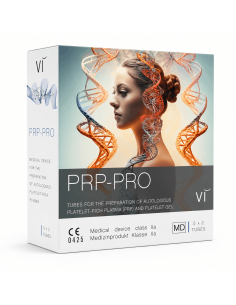
The VI PRP-PRO glass tube offers a modern solution for producing platelet-rich plasma (PRP) and ensures additional stability and reliability in treatments with a wall thickness of 2.4 mm. Developed with innovative technology and EC-certified (0425-MED-004180-00), it guarantees the highest level of safety and efficiency.
Key Features:
Certified...
You need to login or create account
Save products on your wishlist to buy them later or share with your friends.