Hettich EBA 200 MD Type 1810 for PRP & PRF: RCF, RPM, rotor and protocols
A technical and regulatory guide to the Hettich EBA 200 MD: Type 1810, E4413 rotor, RCF/RPM conversion and the correct transfer of PRP and PRF protocols.
Reading time approx. 12 minFor healthcare professionals12.08.2026
Quick answer
The Hettich EBA 200 MD Type 1810 is a Class IIa medical device intended for the separation of human whole blood or blood components. PRP and PRF are not separate intended purposes stated by the centrifuge manufacturer.
In practice, the protocol comes from the tube or preparation system being used. The key parameters are RCF (× g), run time, rotor geometry, tube compatibility and manufacturer instructions. An RPM value from another centrifuge must not simply be copied.
01
Type 1810 or Type 1800? Two versions, two regulatory frameworks
The EBA 200 name covers different regulatory versions. This article focuses on the EBA 200 MD Type 1810, a Class IIa medical device under the MDR. EBA 200 Type 1800 is the IVD version under the IVDR.
The difference is not higher performance. It is the manufacturer-defined intended purpose and the workflow for which the device is placed on the market. Always verify the type number when purchasing and documenting the device.
Feature
Type 1810 · EBA 200 MD
Type 1800 · EBA 200
Regulatory framework
MDR (EU) 2017/745 · Class IIa
IVDR (EU) 2017/746
Rotor
E4413 · 8 positions · 33°
E3694 in Type 1800 documentation
Max. speed
6,000 rpm
6,000 rpm
Max. RCF
3,461 × g
3,461 × g
Important
The MD version does not automatically produce “better PRP”. Its distinguishing feature is the documented intended purpose and regulatory use context.
Technical data of Type 1810
Medical-device status
Class IIa, MDR (EU) 2017/745
CE marking
CE 0483
Standard rotor
E4413, 8-place fixed-angle rotor, 33°
Capacity reference
Current product page / MD datasheet: 8 × 10 ml; check exact vessel geometry in the E4413 rotor table
Max. speed / RCF
6,000 rpm / 3,461 × g
Dimensions / weight
261 × 353 × 228 mm / approx. 9 kg
Max. density
1.2 kg/dm³
Rotor service limit
50,000 cycles or 5 years
Document note: 8 × 10 ml / 8 × 15 ml
Hettich’s current product page and MD datasheet state 8 × 10 ml for Type 1810, while the general technical table in the current instructions also contains 8 × 15 ml. For actual compatibility, the E4413 rotor table, tube diameter, length, adapter and tube-manufacturer information are the more specific reference.
02
Why the MD version matters in autologous blood processing
PRP and PRF workflows process blood outside the body and obtain a blood fraction for subsequent use. Device selection therefore depends on the intended purpose defined by the manufacturer.
In Germany, Section 4 of the Medical Devices Operator Ordinance requires medical devices to be operated according to their intended purpose and manufacturer information. This does not replace the assessment of the tube or PRP/PRF preparation system.
No blanket approval
The medical-device status of the centrifuge does not automatically approve a specific PRP or PRF procedure. The intended purposes of all products used must be compatible.
03
E4413 rotor: Why tube dimensions and effective radius matter
For Type 1810, Hettich documents the E4413 eight-place fixed-angle rotor at 33°. The current product presentation states 8 × 10 ml, while broader Hettich documents contain capacity information that is not fully consistent. For a specific tube, use the E4413 rotor table, outer diameter, tube length, adapters and the tube manufacturer’s approval.
The effective radius is not identical for every vessel. Depending on the vessel configuration, the E4413 documentation includes values around 67 mm and 86 mm. That radius is required for converting between RPM and RCF.
Consequence
The same RPM produces different RCF at 67 mm and 86 mm. Protocol transfer therefore requires the correct effective radius.
04
RCF instead of RPM: only the g-force can be transferred meaningfully
RCF describes the relative centrifugal acceleration acting on the sample. RPM only describes rotor speed. Without the rotor radius, an RPM value cannot be transferred to another centrifuge.
Practical rule
If the tube system specifies a target in × g, use that as the starting point. Hand calculation is mainly useful as a plausibility check.
RCF = 1.118 × 10⁻⁶ × r [mm] × n² [rpm]
RCF/RPM quick calculator for EBA 200 MD
Rotor E4413 · 8 · 33°
Use the radius specified for the actual tube configuration in the E4413 rotor documentation. 86 mm is the documented maximum radius.
Required speed3.533min⁻¹
Resulting RCF1.200× g · r = 86 mm
Orientation only. The tube-system IFU, centrifuge instructions and rotor approval remain binding.
05
RCF reference for E4413 at 67 mm and 86 mm
These are calculated reference values, not PRP or PRF protocols.
Speed
RCF at 67 mm
RCF at 86 mm
1,500 rpm
169 × g
216 × g
2,000 rpm
300 × g
385 × g
2,500 rpm
468 × g
601 × g
3,000 rpm
674 × g
865 × g
3,500 rpm
918 × g
1,178 × g
4,000 rpm
1,198 × g
1,538 × g
5,000 rpm
1,873 × g
2,404 × g
6,000 rpm
2,697 × g
3,461 × g
Do not use as a protocol
The table only shows the relationship between radius, speed and RCF. Permitted process parameters come from the IFU of the relevant system.
06
PRP with the EBA 200 MD: system-specific, not a universal recipe
PRP systems differ in anticoagulant, separation gel, tube geometry, fill volume and centrifugation workflow. There is therefore no universal “PRP setting” for the EBA 200 MD.
Single-spin and double-spin are different preparation strategies. The intended strategy is defined by the relevant system; the number of spins alone does not establish the quality of the resulting PRP.
Document as well
tube/system and lot
target RCF and run time
rotor and effective radius
loading and balancing
braking/deceleration profile if specified by the system
07
From the system protocol to the device setting: Vi PRP-PRO
For Vi PRP-PRO, a system-specific reference protocol of 1,200 × g for 7 minutes is documented. This value belongs to the tube system, not to the centrifuge.
At an effective radius of 86 mm, 1,200 × g corresponds to approximately 3,530 rpm. At 67 mm it would require about 4,000 rpm. The actual tube radius in the E4413 is therefore essential.
Key point
1,200 × g / 7 min is a Vi PRP-PRO value, not a general Hettich EBA 200 MD setting.
1,200 × g · r = 86 mm → approx. 3,530 rpm
08
PRF: centrifugation is only one part of the workflow
PRF systems generally operate without anticoagulant. The interval between blood collection, filling and centrifuge start therefore becomes a relevant process parameter. Tube material, surface, rotor geometry, RCF, run time and deceleration may also matter.
Published values for i-PRF, A-PRF or other PRF variants describe specific study configurations. They are not manufacturer-approved EBA 200 MD protocols.
PRF protocols from the literature: examples, not EBA 200 MD settings
The following values describe defined study configurations. They are included for scientific context and are not manufacturer-approved settings for the EBA 200 MD or for another tube system.
Variant
Published protocol
Study context
EBA 200 MD classification
L-PRF
approx. 400 × g · 12 min
Dohan Ehrenfest et al.; defined L-PRF centrifuge/tube configuration
Do not transfer 1:1
A-PRF
1,500 rpm · 14 min
Ghanaati et al.; defined centrifuge and tube configuration
RPM is system-bound
i-PRF
700 rpm · approx. 60 × g · 3 min
Miron et al.; in-vitro study with defined centrifuge
No E4413 approval
No universal PRF settings
An RPM value published for another centrifuge is not an EBA 200 MD protocol. Literature values must be interpreted in the context of the actual study configuration.
Step 1Blood collectionFollow the defined system workflow
Step 2Tube fillingMaintain the specified fill volume
Step 3LoadingBalance symmetrically
Step 4RCF & run timeAccording to the PRF-system IFU
Step 5DecelerationUse the specified brake profile
Step 6Further processingFollow the defined system workflow
09
Manufacturer-backed, calculated, literature-based or unsupported?
For SOPs and training, it should be obvious what status each number has. This avoids mixing manufacturer instructions with literature values or internal calculations.
Status
Meaning
Use
Manufacturer/IFU
RCF and time come from documentation for the specific system
Starting point for the workflow
Calculated transfer
IFU RCF converted to RPM using a documented radius
Device setting with radius documented
Literature reference
Value from a study with a defined configuration
Scientific context
Unsupported
RPM from another device/forum without a valid system basis
Not a work instruction
Keep categories separate
This distinction also helps search engines and AI systems separate product-specific parameters from general literature values.
Example of a traceable protocol overview
System
Purpose
Target RCF
Time
EBA 200 MD speed
Status
Vi PRP-PRO
PRP, single-spin
1,200 × g
7 min
≈ 3,530 rpm at r = 86 mm
Product value + calculation
PRF system A
liquid PRF
according to IFU
according to IFU
calculate from IFU RCF
Calculated only
PRF system B
PRF membrane
according to IFU
according to IFU
calculate from IFU RCF
Calculated only
“PRP in general”
—
—
—
—
Unsupported
10
Moving from another centrifuge: what can be transferred?
The intended RCF and run time of a validated system protocol may be the starting point. RPM must be recalculated using the effective radius of the new rotor.
Tube dimensions, rotor approval, loading, brake profile and all manufacturer instructions must also be checked. A mathematically equivalent g-force does not by itself prove full system compatibility.
What is transferable when changing centrifuges?
Parameter
Transferable?
Reason
RCF (× g)
Conditionally
Physically comparable, but only within a compatible documented system
Run time
Conditionally
Only together with the remaining protocol and confirmed compatibility
RPM
No
Valid only for the radius for which it was determined
Acceleration/deceleration setting
Conditionally
Device-specific scale; compare the intended behaviour, not the setting number
More than a calculation
Mechanical compatibility and intended purpose cannot be derived from the RCF formula.
11
Seven common errors in PRP/PRF centrifugation
Most errors result from mixing device specifications, tube-system protocols and literature values rather than from the centrifuge itself.
Common errors
copying RPM from another centrifuge
using the maximum radius for every tube
confusing Type 1800 with Type 1810
checking only nominal ml capacity instead of dimensions
failing to document loading and balance
presenting a literature protocol as manufacturer approval
ignoring braking profile and the defined system workflow
12
Where the EBA 200 MD fits – and where its limits remain
The EBA 200 MD is therefore a technical platform for defined centrifugation workflows. Suitability for a specific PRP or PRF system depends on intended purpose, tube approval and process parameters together.
Strengths
MDR medical device Type 1810 with documented intended purpose
E4413 fixed-angle rotor with 8 positions
up to 6,000 rpm and 3,461 × g
RCF/RPM conversion using a documented radius
compact footprint for practice and clinic
Limits
no manufacturer-defined universal PRP/PRF preset
tube compatibility must be assessed individually
fixed-angle rather than swing-out rotor
no active refrigeration
throughput limited to 8 rotor positions
FAQ
Frequently asked questions about the Hettich EBA 200 MD
Is the Hettich EBA 200 MD a PRP centrifuge?
It is intended as a medical device for separating human whole blood or blood components. PRP is not a separate manufacturer-stated intended purpose. The specific PRP protocol comes from the preparation system used.
Can the EBA 200 MD be used for PRF?
Technically it covers typical RCF ranges. Whether a specific PRF system may be processed with it depends on the system IFU, tube format, rotor approval and process parameters.
What RPM corresponds to 1,200 × g?
At an effective radius of 86 mm, approximately 3,530 rpm; at 67 mm, approximately 4,000 rpm. Without the radius, an RPM value is ambiguous.
What is the difference between Type 1810 and Type 1800?
Type 1810 is the MDR medical-device version; Type 1800 is the IVDR IVD version. The type number is therefore important when ordering and documenting the device.
Can I copy a PRF protocol from another centrifuge?
RCF and run time can only serve as a starting point if they belong to the actual system. RPM must be recalculated for the EBA 200 MD rotor radius, and system compatibility must still be checked.
Why is the MD version more expensive?
Public Hettich documents do not disclose the manufacturer’s price calculation. What can be documented is that Type 1810 is placed on the market as a Class IIa medical device with CE 0483 and therefore follows a different regulatory framework from Type 1800. The medical-device status itself does not prove better PRP or PRF results.
Which tube sizes fit the E4413 rotor?
The E4413 rotor table lists, among others, 9–10 ml, 10 ml and 5–10 ml vessel groups with defined dimensions. Hettich documents currently contain different higher-level capacity statements, so tube selection should be based on the specific rotor table, diameter, length, adapter and tube-manufacturer information.
Do I necessarily need the MD version for PRP?
No rule requires this specific centrifuge for every PRP procedure. Device selection depends on the concrete workflow and the intended purposes of all products used. In Germany, Section 4 MPBetreibV requires devices to be used according to their intended purpose.
Sources
Manufacturer documents, legal framework and scientific context
Note: This technical article is intended for healthcare professionals and provides technical and regulatory context. It does not replace the centrifuge instructions or the IFU of the tube/preparation system. The respective manufacturer instructions and applicable regulations remain binding.
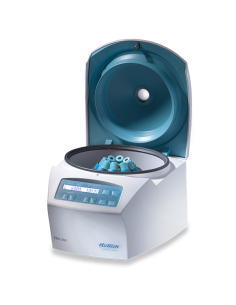
Hettich EBA 200 MD, type 1810 – Class IIa medical device under MDR (EU) 2017/745. For professional separation of human whole blood or blood components.
8-place E4413 angle rotor, 33°
Tubes up to 10 ml*
Max. 6,000 RPM / 3,461 RCF
CE 0483
* Compatibility depends on tube dimensions and manufacturer specifications.
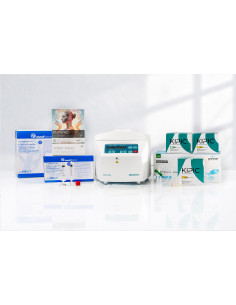
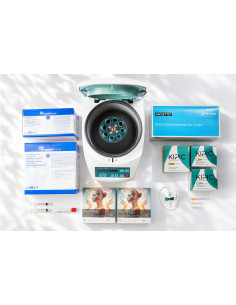
Set includes:
1x Hettich EBA 200 MD centrifuge – Class IIa medical device
2x PRP tubes | Vi PRP-Pro, pack of 10 pcs
1x KIPIC® needle 25G x 42 mm, pack of 100 pcs
1x KIPIC® mesotherapy needle 30G x 4 mm, pack of 100 pcs
1x KIPIC® mesotherapy needle 32G x 4 mm, pack of 100 pcs
1x Mediware disposable syringes 5 ml, 3-piece, Luer-Lock, sterile, pack of...
You need to login or create account
Save products on your wishlist to buy them later or share with your friends.